Overwintering Herbs: Bring It In, Take a Cutting, or Start Again?
In short: You do not need to save every pot. English lavender, thyme, sage and mint stay outside. Rosemary stays out but needs shelter below about −8°C (18°F). Lemon verbena and scented pelargoniums must be under cover, frost-free, before the first frost. Basil is not worth carrying through winter: harvest it and sow again in spring.
The first frost is forecast, the windowsill holds four pots and you have eleven. Overwintering herbs is a sorting job, and most of the losses come from treating every plant the same way.
This guide sorts nine scented plants into five groups, so you know which ones to leave, which to wrap, which to carry in and which to let go. It is written for pots on a balcony, patio or doorstep.
Table of Contents
Three questions before you move anything
- How cold does it get where you live? Look up your usual lowest winter temperature and your average first frost date. Every decision below hangs on those two numbers.
- How wet is your winter? For Mediterranean herbs, cold and wet together do the damage. The RHS warns that cold, wet compost can cause rosemary roots to rot and die.
- How much bright, frost-free space do you have? Count only what you really have. A cool, bright stairwell, an unheated room or a porch is more useful than a warm, dark kitchen.
The months we mention describe a Central European garden like ours, with cold winters and hot, dry summers. Use your own frost date and shift everything to match.
Overwintering herbs at a glance: the decision table
| Plant | How hardy | What to do | Take a backup cutting? |
|---|---|---|---|
| English lavender | Hardy. ‘Hidcote’ to between −15 and −10°C (5 to 14°F) | Keep outside, keep dry | Not needed |
| French and other tender lavenders | Less hardy, short-lived | Move somewhere frost-free | Worth trying |
| Thyme | Hardy, hates winter wet | Keep outside, in a sheltered, dry spot | Not needed |
| Sage | Hardy, roots rot in wet | Keep outside, in the rain shadow of a wall | Not needed |
| Mint | Fully hardy, dies back | Keep outside. Bring one pot in if you want winter leaves | Not needed |
| Rosemary | To about −8°C (18°F) | Protect: sheltered wall, wrapped pot, fleece in hard frost | Yes, as insurance |
| Lemon verbena | Only to between −5 and 1°C (23 to 34°F) | Move under cover, frost-free, before the first frost | Yes |
| Scented pelargonium | Will not take frost | Move indoors to a bright place at 7–10°C (45–50°F) | Yes, the easiest of all |
| Basil | Not hardy at all | Harvest and start again in spring | No |
The five choices, one by one
1. Keep it outside
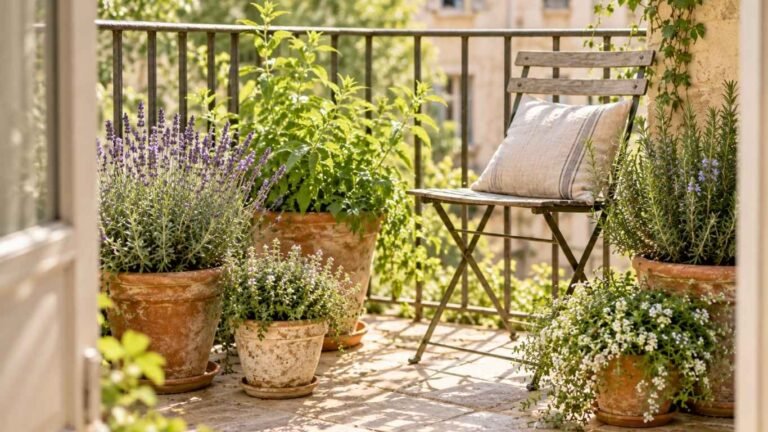
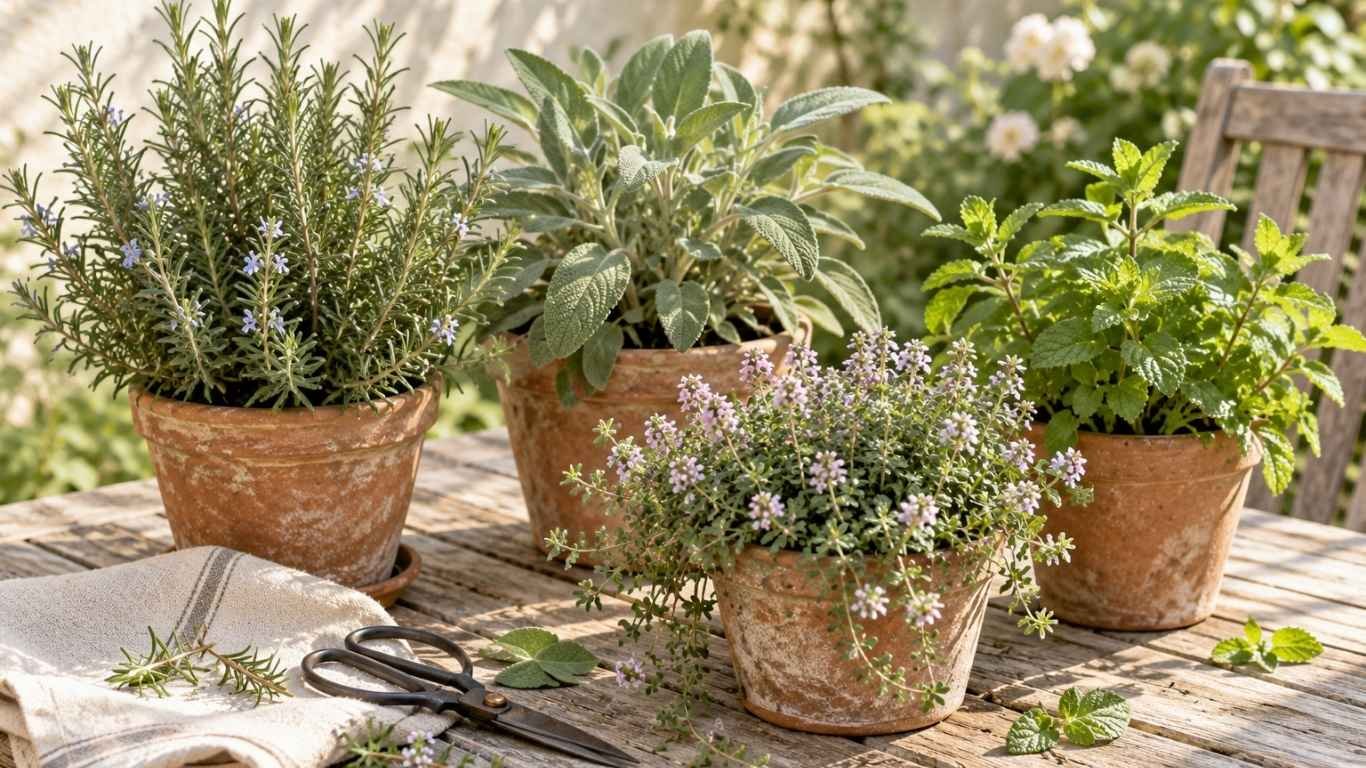
English lavender, thyme, sage and mint belong here. The RHS describes English lavenders as the hardiest types, usually able to stay outside all winter. Mint is a fully hardy perennial that dies back over winter and regrows every spring, so an empty-looking pot in January is normal.
What these plants fear is water, not frost. Thyme dislikes damp conditions, especially in winter, which can cause the roots to rot. Move the pots out of the rain: under the eaves, against a house wall or into the lee of a fence.
If your lavender struggles every winter, the pot and the compost are the likely cause. See lavender in pots: why it dies and how to grow it successfully.
2. Protect it where it stands
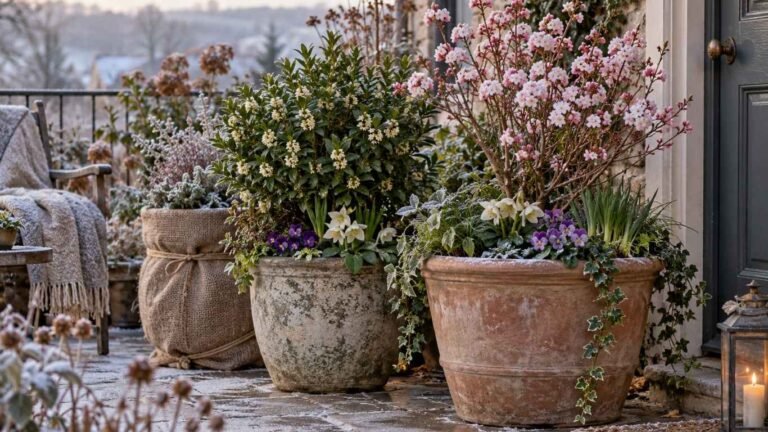
Rosemary is the main plant in this group. It survives down to about −8°C (18°F), which covers many winters and fails in a hard one. Plants in containers are more exposed than plants in the ground, because the roots sit above soil level.
The RHS advice for containers in winter is simple, and it works on a balcony:
- Group pots together in a dry, sheltered place, so they protect each other.
- Wrap the pot itself in bubble wrap, straw or an old blanket to stop the roots freezing.
- In a severe cold spell, cover the top growth for a while with fleece, hessian or an old bedsheet.
- Keep the compost on the dry side. Never let it sit waterlogged.
If your winters regularly fall well below −8°C (18°F), treat rosemary as a move-indoors plant and give it your coolest bright room.
3. Move it indoors
Lemon verbena and scented pelargoniums are the two scented plants that truly need to come in.
Lemon verbena is rated hardy only to between −5 and 1°C (23 to 34°F). It is deciduous, so it drops its leaves in winter. A bare lemon verbena is resting. Keep it frost-free and bright, and water very little until growth starts again in spring.
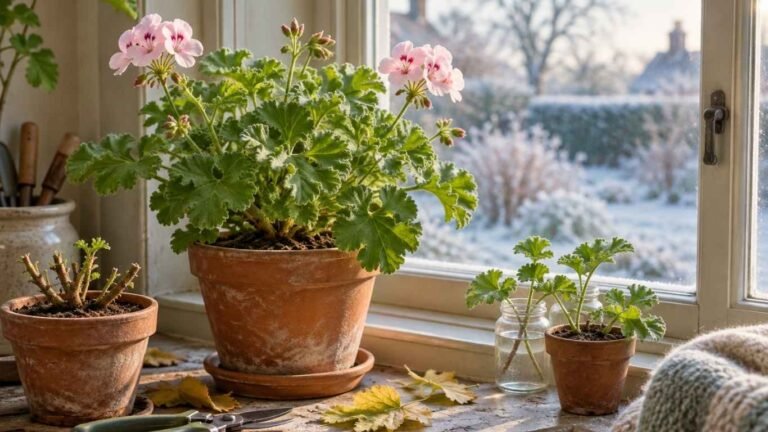
Scented pelargoniums will not take frost. The RHS advises bringing container-grown pelargoniums under cover before the first autumn frosts and keeping them in a light, airy, frost-free position at 7–10°C (45–50°F). Check them weekly and water only when the compost is dry.
Check before you bring a plant in. A pot that has stood outside all summer may carry aphids or other passengers. Look under the leaves and along the stems, remove dead leaves from the compost surface, and keep the plant apart from your houseplants for a couple of weeks while you watch it.
Choose the coolest bright place you have. A warm living room with little light gives you long, pale, weak shoots. A cool windowsill, a bright stairwell or an unheated room suits these plants far better.
4. Take a backup cutting
A cutting is insurance. If the parent plant dies in February, you still have the variety. It also solves the space problem: six cuttings fit where one large pot would stand.
The RHS takes semi-ripe cuttings, from this season’s growth, from late summer until mid-autumn, and lists lavender, rosemary, sage and thyme among the herbs that suit the method. It also warns that winter is too late, so plan ahead. In mid-October you are at the end of that window. Cuttings taken now root more slowly and fewer will succeed, so take more than you need.
How to take a semi-ripe cutting:
- Choose healthy shoots from this year’s growth, without flowers.
- Trim each to 10–15 cm (4–6 in), cutting just below a leaf joint.
- Remove the lowest leaves and the soft tip, leaving about four leaves.
- Push the cuttings into a pot of half peat-free potting compost and half sharp sand.
- Cover the pot with a clear plastic bag, or put it in a propagator.
- Stand it somewhere warm and light, out of direct sun, and keep the compost just moist.
Pelargoniums are easier still. Softwood cuttings can be taken from spring to autumn, and the RHS suggests overwintering them in trays of compost on a well-lit indoor windowsill, watered sparingly. Rooted cuttings of tender plants are kept on the dry side in bright, frost-free conditions at about 7°C (45°F).
5. Harvest it and start again
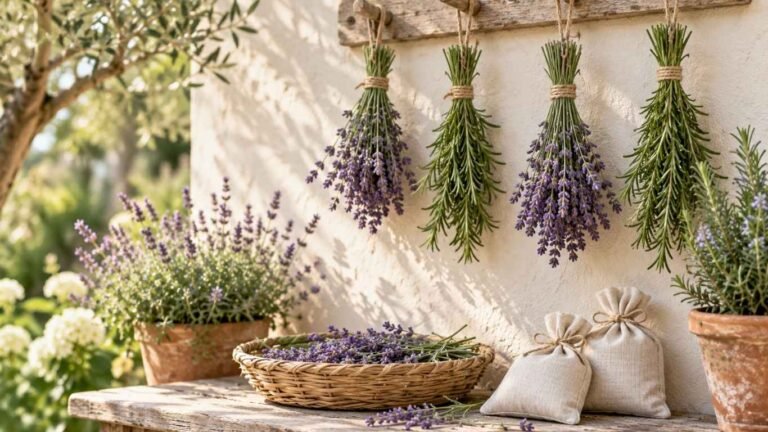
Some plants are not worth the windowsill. Basil is not hardy and needs warm conditions, with nights above 10°C (50°F). You can keep a pot going for a few weeks on a bright indoor sill, but by midwinter it is usually thin and tired. Pick it, use it and sow fresh seed between March and July. Whatever you harvest from the hardier herbs can be dried, and we show how in gifts from the garden.
The same choice is reasonable for any plant that is old, woody or cheap to replace. Saving a plant costs space, light and attention for five months. Spend those on the ones you would miss.
What not to do in autumn
- Do not prune hard now. Lavender is trimmed in late summer, just after flowering. Sage is pruned in mid to late spring. Neither reshoots reliably from old, bare wood, so a hard cut now risks losing the plant.
- Do not feed. Soft new growth is the first thing frost damages.
- Do not water on a schedule. Plants that are resting use very little. Check the compost with a finger and water only when it is dry.
- Do not leave it until the night of the frost. Tender plants should be under cover before the first frost, not after it.
Overwintering herbs pot by pot: your own decision
Walk round your pots with these four questions. Stop at the first “yes”.
- Is it hardy where I live? Keep it outside and keep it dry.
- Is it borderline, and too big to move? Protect it where it stands, and take cuttings.
- Is it tender, and would I miss it? Move it indoors, to a cool, bright place.
- Is it tender, tired or easy to replace? Harvest it and start again in spring.
Pets and children
Plants that come indoors come within reach. The ASPCA lists lavender, pelargoniums (often sold as geraniums), lemon verbena and mint as toxic to dogs and cats if eaten, and lists rosemary as non-toxic. If you have a pet that chews leaves, choose a room it cannot get into, and check each plant in the ASPCA plant database.
Frequently asked questions
Which herbs can stay outside in winter?
English lavender, thyme, sage and mint are hardy and usually stay outside. Keep their pots in a sheltered place out of the rain, because wet compost does more harm than cold. Mint dies back and returns in spring.
When should I bring herbs indoors for winter?
Before your first autumn frost. Tender plants such as lemon verbena and scented pelargoniums can be damaged by a single frosty night. Check your local average first frost date and move them a week or two ahead of it.
Can rosemary survive winter in a pot?
Rosemary survives down to about −8°C (18°F). In a pot it needs a sheltered spot, a wrapped container and fleece over the top in severe cold. Cold, wet compost is the main killer, so keep it on the dry side.
How do I overwinter lemon verbena?
Move it under cover before the first frost and keep it frost-free and in good light. It is deciduous and drops its leaves, which is normal. Water very sparingly until new growth appears in spring.
Is it too late to take cuttings in October?
It is late but still possible. Semi-ripe cuttings are best taken from late summer to mid-autumn, and winter is too late. Take more than you need and expect some to fail. Pelargonium cuttings can be taken from spring to autumn.
Should I bring basil indoors or start again?
Start again. Basil is not hardy and needs warmth and strong light, so it rarely stays healthy through winter. Harvest what you have and sow fresh seed from March.
Your next step
Find your first frost date today. Then sort your pots into the five groups and move the tender ones first.
If you are choosing what to grow next year, our beginner’s guide to creating a scented garden marks which plants are hardy and which are tender before you buy.
Tell us in the comments: which plant are you stuck on, and what are your winters like?
Sources
- RHS: How to grow lavender
- RHS: Lavandula angustifolia ‘Hidcote’
- RHS: How to grow rosemary
- RHS: How to grow thyme
- RHS: How to grow sage
- RHS: How to grow mint
- RHS: How to grow basil
- RHS: Aloysia citrodora, lemon verbena
- RHS: How to grow pelargoniums
- RHS: Scented-leaf pelargoniums
- RHS: Semi-ripe cuttings
- RHS: Tender perennials: cuttings
- RHS: Preventing winter damage
- ASPCA: Toxic and non-toxic plants
Last updated: 4 October 2026 · Scented Garden