Winter Pots That Smell Good: 8 Fragrant Plants for a Balcony or Doorstep
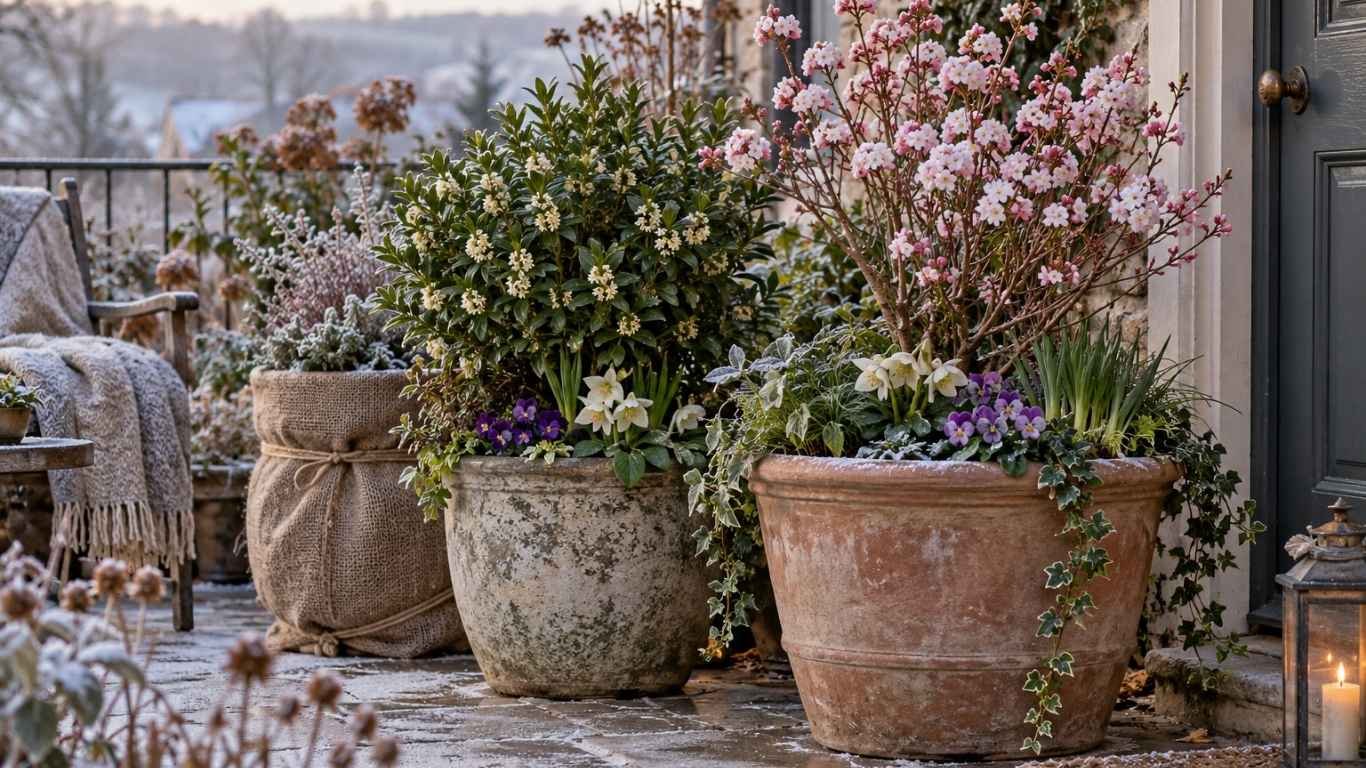
In short: Build each winter pot around one hardy, scented shrub: sweet box for shade, Viburnum farreri ‘Nanum’ for sun. Then tuck fragrant bulbs and sweet violets around its edge. Choose plants rated H5 or hardier by the RHS (hardy to −10°C / 14°F or colder) for pots that stay out all winter. Use a frost-proof pot at least 30 cm (12 in) wide, and wrap it in hard frost.
Between November and March most balconies go quiet: an empty pot, a few brown stems, a chair nobody sits on. Yet some of the sweetest scents of the whole year belong to winter, and several of them grow happily in winter pots by a door.
This guide gives you eight fragrant plants that cope with a cold winter in a container, when each one is in scent, how to stop the pots freezing solid, and two pot plans you can copy this month.
Table of Contents
Before you buy: the frost rule for winter pots
A plant that is hardy in the ground can still die in a pot. Roots in a container have no soil around them to buffer the cold, so they freeze harder and faster. The RHS hardiness ratings say this plainly: plants in pots are at increased risk, and even many very hardy plants grown in containers will be damaged unless given protection.
| RHS rating | Hardy to | In a winter pot |
|---|---|---|
| H4 | −10 to −5°C (14 to 23°F) | Only if you can move the pot somewhere sheltered in hard frost |
| H5 | −15 to −10°C (5 to 14°F) | Fine by a sheltered wall; wrap the pot in hard frost |
| H6 | −20 to −15°C (−4 to 5°F) | The safest choice for an exposed balcony |
In a Central European winter, where nights of −10 to −15°C are possible, that means H5 or H6 for any pot that stays out. Keep H4 plants for a spot you can reach quickly.
Five habits that keep winter pots alive
- Use frost-proof pots. A pot that is not sold as frost-proof can crack when wet compost freezes inside it.
- Go bigger. At least 30 cm (12 in) wide for a single shrub. More compost freezes more slowly.
- Raise them on pot feet so water drains away and the base does not sit in ice.
- Group pots by a wall. The RHS advises keeping containers in dry, sheltered places, grouped together for mutual protection.
- Wrap in hard frost. Bubble polythene or straw around the pot stops the roots freezing, again following the RHS. Leave the top open so the plant can breathe.
Evergreens still lose water on mild, windy days. Water winter pots in a dry spell when the compost is not frozen, and never leave a saucer of water under them.
8 fragrant plants for winter pots
Every plant below has a fragrance entry on its RHS page. Choose one shrub per pot, then underplant with bulbs or violets.
1. Sweet box (Sarcococca confusa)
The best winter scent for a shady doorway. An evergreen with glossy leaves and small, creamy-white flowers in winter that the RHS calls very sweetly scented. You smell it long before you see the flowers.
- Light: full or partial shade
- Pot: 40–45 cm (16–18 in) for a young plant; it grows to 1–1.5 m
- Scent family: Sweet · In scent: winter, roughly December to February; strongest on mild, still days
- Hardiness: H5 · Effort: low
2. Dwarf sweet box (Sarcococca hookeriana var. humilis)
The same scent in a smaller plant: a compact shrub to about 60 cm, with very fragrant creamy-white flowers with crimson anthers in winter. The one to choose for a narrow balcony.
- Light: full or partial shade
- Pot: 30–35 cm (12–14 in)
- Scent family: Sweet · In scent: winter, roughly December to February
- Hardiness: H5 · Effort: low
3. Dwarf fragrant viburnum (Viburnum farreri ‘Nanum’)
The hardiest plant on this list and the earliest in scent. A compact, mounding shrub to about 1 m, with clusters of small, fragrant white flowers opening from pink buds in late autumn and winter. It loses its leaves, so the flowers sit on bare twigs.
- Light: full sun or partial shade
- Pot: 40 cm (16 in)
- Scent family: Sweet · In scent: late autumn and winter, roughly November to February
- Hardiness: H6 · Effort: low
4. Winter daphne (Daphne odora ‘Aureomarginata’)
One of the strongest scents at the end of winter. A compact evergreen with yellow-edged leaves and clusters of fragrant purplish-pink flowers in early spring. It is only rated H4, so grow it in a pot you can carry into an unheated porch or stairwell when a hard frost is forecast.
- Light: full sun or partial shade, sheltered
- Pot: 35–40 cm (14–16 in), very free-draining compost
- Scent family: Floral · In scent: early spring, roughly late February to March
- Hardiness: H4 · Effort: medium (it needs moving in hard frost)
5. Skimmia (Skimmia japonica ‘Rubella’)
Colour all winter, scent at the end of it. Panicles of red buds stay showy through late winter, then open into fragrant white flowers in early spring. It prefers acid to neutral soil, so use ericaceous compost in the pot.
- Light: partial shade
- Pot: 30–35 cm (12–14 in)
- Scent family: Sweet · In scent: early spring, roughly March to April; red buds are the show before that
- Hardiness: H5 · Effort: low
6. Snowdrop ‘S. Arnott’ (Galanthus ‘S. Arnott’)
A larger snowdrop, about 15 cm tall, with nodding, fragrant white flowers. Bend down on a sunny day and you will catch it. Plant the bulbs in autumn around the edge of a shrub pot.
- Light: partial shade
- Pot: around the rim of a shrub pot, or 10 bulbs in a 20 cm (8 in) pot
- Scent family: Sweet · In scent: late winter, roughly February
- Hardiness: H5 · Effort: low
7. Crocus ‘Cream Beauty’ (Crocus chrysanthus ‘Cream Beauty’)
Fragrant cream flowers with a deep yellow throat, up to 10 cm tall. It needs full sun to open, so give it the sunniest pot.
- Light: full sun
- Pot: under a sun-loving shrub, or 15 corms in a 20 cm (8 in) bowl
- Scent family: Sweet · In scent: late winter to early spring, roughly February to March, when the flowers are open in sun
- Hardiness: H6 · Effort: low
8. Sweet violet (Viola odorata)
Low, heart-shaped leaves and fragrant violet or white flowers about 2 cm across in late winter and early spring. It spreads to fill the edge of a pot and comes back every year.
- Light: full sun or partial shade
- Pot: around the rim of a shrub pot
- Scent family: Floral · In scent: roughly February to April
- Hardiness: H6 · Effort: low
Your winter pots scent calendar
The RHS gives seasons, not months. The months below are how those seasons usually fall in a Central European garden. Shift them a few weeks earlier in a mild coastal garden and later in a cold, high one.
| Plant | Nov | Dec | Jan | Feb | Mar | Apr |
|---|---|---|---|---|---|---|
| Viburnum farreri ‘Nanum’ | ● | ● | ● | ● | ||
| Sweet box and dwarf sweet box | ● | ● | ● | |||
| Snowdrop ‘S. Arnott’ | ● | |||||
| Crocus ‘Cream Beauty’ | ● | ● | ||||
| Winter daphne | ● | ● | ||||
| Sweet violet | ● | ● | ● | |||
| Skimmia ‘Rubella’ (flowers) | ● | ● |
Two pots are enough to cover the whole stretch: one built around the viburnum or sweet box for the dark months, and one with daphne, crocus and violets for the end of winter.
Which winter pot plant is yours?
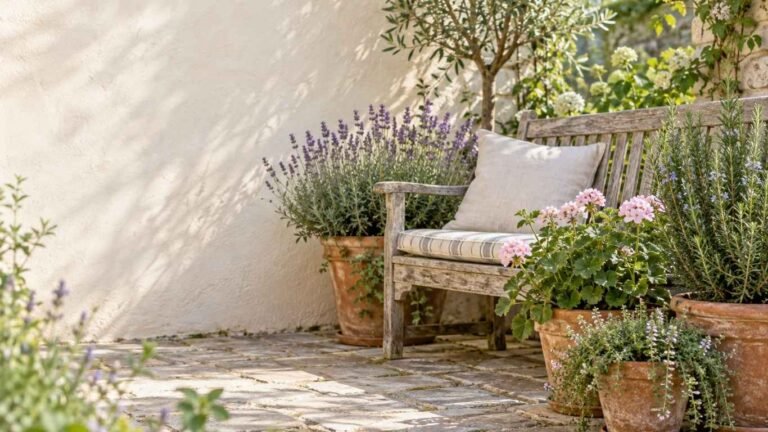
- Shady door or north-facing balcony: sweet box, or dwarf sweet box if space is tight.
- Sunny, exposed balcony: Viburnum farreri ‘Nanum’, the hardiest of the eight.
- Sheltered corner and a porch to retreat to: winter daphne, for the strongest scent.
- You want colour as well as scent: skimmia ‘Rubella’ for its red winter buds.
- Only one small pot: dwarf sweet box with snowdrops and violets around it.
Two winter pot plans to copy
Plan 1: the shady doorstep
- 1 dwarf sweet box in the centre of a 35–40 cm (14–16 in) frost-proof pot
- 10 snowdrop ‘S. Arnott’ bulbs in a ring around it, planted in autumn
- 3 sweet violets at the rim
Scent runs from December (sweet box) through February (snowdrops) into April (violets). Stand it beside the door you use most, where you pass it twice a day.
Plan 2: the sunny balcony corner
- 1 Viburnum farreri ‘Nanum’ in a 40 cm (16 in) frost-proof pot
- 15 crocus ‘Cream Beauty’ corms around it, planted in autumn
- Beside it, a separate pot of winter daphne you can carry indoors in hard frost
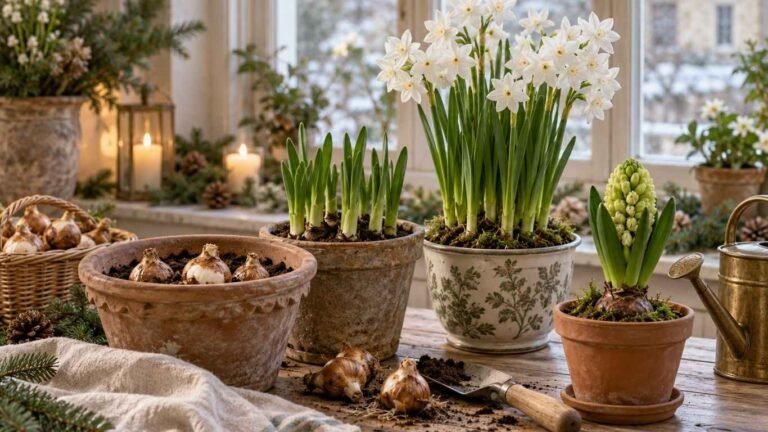
The viburnum flowers on bare stems from late autumn; the crocus and daphne take over in late winter. If you also want scent indoors over Christmas, plant a bowl of paperwhites indoors at the same time.
Pets and children
The RHS lists winter daphne as toxic if eaten, a skin irritant and toxic to pets; wear gloves when you handle or prune it. Sweet box produces black berries after flowering, which the RHS says are ornamental and not to be eaten. Keep both out of reach of children and pets that chew plants, and keep spare bulbs in a closed box until they are planted.
Frequently asked questions
What plants smell good in winter pots?
Sweet box, dwarf sweet box, Viburnum farreri ‘Nanum’ and winter daphne are the strongest. Snowdrop ‘S. Arnott’, crocus ‘Cream Beauty’ and sweet violets add scent at the end of winter.
Can winter pots stay outside all winter?
Yes, if the plants are hardy enough for your coldest nights and the pots are protected. Choose RHS H5 or H6 plants, use frost-proof pots on feet, group them by a wall and wrap them in bubble polythene or straw in hard frost.
What is the best fragrant plant for a shady balcony?
Sweet box. It grows in full or partial shade and its small winter flowers are very sweetly scented. Choose the dwarf form if your balcony is narrow.
When do winter-scented plants flower?
The viburnum starts in late autumn, sweet box follows in winter, and snowdrops, crocus, daphne and sweet violets flower in late winter and early spring. In a Central European garden that spreads scent from November to April.
Do winter pots need watering?
Yes, a little. Evergreens keep losing water on mild, windy days. Water in a dry spell when the compost is not frozen, and let the excess drain away.
Is sweet box safe for pets?
The RHS says its berries are ornamental and not to be eaten, so keep it away from pets and children that chew plants. Winter daphne is more of a concern: the RHS lists it as toxic to pets.
Your next step
Choose your darkest doorway or your coldest corner, and give it one scented shrub this month while garden centres still have them. Add the bulbs around it before the ground freezes.
Tell us in the comments: where would a winter pot go in your space, and which way does it face?
For a ready-made shade recipe with sweet box, cyclamen and violas, see Autumn Scent Recipes for Pots. If one of your pots holds lavender, read how to keep lavender in pots alive through winter.
Sources
- RHS: Hardiness ratings
- RHS: Preventing winter damage
- RHS: Sarcococca confusa
- RHS: Sarcococca hookeriana var. humilis
- RHS: Viburnum farreri ‘Nanum’
- RHS: Daphne odora ‘Aureomarginata’
- RHS: Skimmia japonica ‘Rubella’
- RHS: Galanthus ‘S. Arnott’
- RHS: Crocus chrysanthus ‘Cream Beauty’
- RHS: Viola odorata
Last updated: 10 October 2026 · Scented Garden