Autumn Scent Recipes for Pots: Bulb Lasagnes, Fragrant Planting Ideas & an Evening Garden Plan
Create a beautiful, fragrant patio or balcony with simple autumn planting recipes, layered spring bulbs and five carefully chosen pots for magical evenings outdoors.
In Short: Your Autumn Scent Garden at a Glance. Autumn is the perfect time to turn even the smallest patio, balcony or doorstep into a beautiful scented garden. With a few thoughtfully chosen pots, fragrant herbs and spring-flowering bulbs, you can enjoy seasonal colour now while preparing for wonderful fragrances in the months ahead.
Start with three simple ideas: create an aromatic container with rosemary and thyme, plant a scented bulb lasagne with hyacinths and fragrant narcissus for spring, and plan an Evening Scent 5-Pot Garden with jasmine, nicotiana and other fragrant flowers for next summer.
The secret is to plan around when you enjoy your garden most. Choose plants that suit your sunlight, space and local UK climate, then record your favourite combinations in a garden journal or printable recipe cards. You don’t need a large garden or an expensive makeover—just a few beautiful containers and a little seasonal inspiration. Discover autumn scent recipes for pots now.
Table of Contents
There is something rather lovely about gardening in autumn.
The mornings feel cooler, the light turns golden, and the garden begins to slow down. Summer’s exuberant flowers give way to softer colours, changing leaves and the satisfying ritual of preparing for another season.
Perhaps your favourite part of the day is stepping outside with a cup of tea. Perhaps you enjoy a quiet half-hour with your gardening notebook, planning what to grow next. Or perhaps you have a little patio that you would love to transform into somewhere beautiful to sit at the end of a busy day.
Whatever your space, autumn is a wonderful time to begin thinking about fragrance.
Not simply which flowers will look pretty in a pot, but which scents you would love to experience, when you want to experience them, and how to bring those moments into your everyday life.
You certainly don’t need a large country garden. A few thoughtfully planted containers can create something surprisingly special.
Today, we’re exploring three ways to make a small garden smell as beautiful as it looks:
- Scent recipes for pots: easy combinations of fragrant herbs, flowers and seasonal foliage.
- Scented bulb lasagne recipe cards: beautiful layers of spring bulbs planted in autumn for colour and perfume next year.
- The Evening Scent 5-Pot Plan: a fragrant little retreat designed around the hours when you actually enjoy your garden.
And because planning is half the pleasure, we’ll also explore how to create your own seasonal scent journal.
The Autumn Garden: Less About More Plants, More About Better Experiences
Gardening is becoming increasingly thoughtful.
The Royal Horticultural Society’s 2026 gardening predictions highlight the importance of resilient plants, practical container growing and plants that offer more than one benefit.
For a small scented garden, that opens up some rather delightful possibilities.
1. Small-space gardens with a purpose
Instead of collecting pots simply because a plant catches our eye at the garden centre, we can design each container for a particular experience.
A pot of rosemary beside the kitchen door. Fragrant hyacinths near the entrance in spring. A sweetly scented flower by the chair where we sit on summer evenings.
Every pot has a reason for being there.
2. Seasonal layering instead of seasonal replacement
A beautifully planted container doesn’t have to offer everything at once.
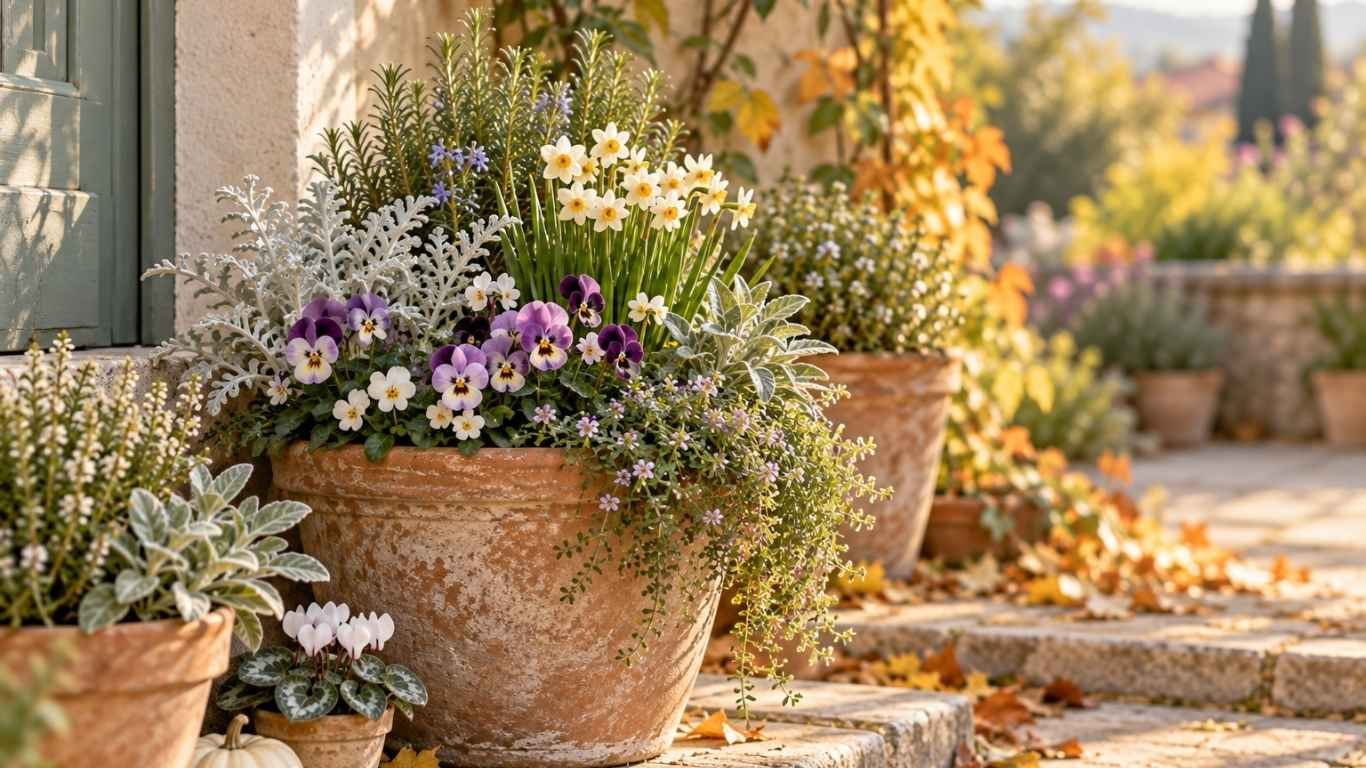
Autumn violas can provide colour now, while bulbs beneath the compost quietly prepare for spring.
By choosing varieties that bloom at different times, you can create a succession of flowers without repeatedly starting from scratch.
3. Sensory gardening as a daily ritual
A garden can be somewhere we reconnect with the seasons.
The herbal scent of rosemary as we brush past it. The first hyacinth flowers after winter. The sweetness of night-scented stock drifting towards an open window.
These are small moments, but often the most memorable ones.
And a garden journal makes them even more rewarding, allowing us to remember what worked, what surprised us and what we’d love to grow again.
Before You Plant: Discover Your Garden’s Scent Personality
Here’s a question worth asking before buying anything:
When do you actually spend time in your outdoor space?
The answer is often more useful than choosing plants by appearance alone.
| Your favourite garden moment | Try this scent family | Plants to consider |
|---|---|---|
| Morning tea outside | Fresh, herbal | Rosemary, thyme, scented pelargonium |
| Walking through the front door | Sweet, floral | Hyacinth, fragrant narcissus, sweet box |
| A sunny afternoon | Mediterranean, aromatic | Rosemary, lavender, thyme |
| Sitting outdoors at dusk | Floral, evening fragrance | Nicotiana, night-scented stock, star jasmine |
| Looking forward to spring | Fresh, sweet, floral | Hyacinth, fragrant narcissus |
Also consider the amount of sunlight your space receives.
A sunny, sheltered patio offers very different possibilities from a north-facing doorway, and the same combination will not thrive everywhere.
The secret is to choose plants that suit both your lifestyle and your growing conditions.
Scent Recipe No. 1: The Golden-Hour Herb Pot
For sunny patios, sheltered balconies and anyone who loves the scent of a Mediterranean garden.
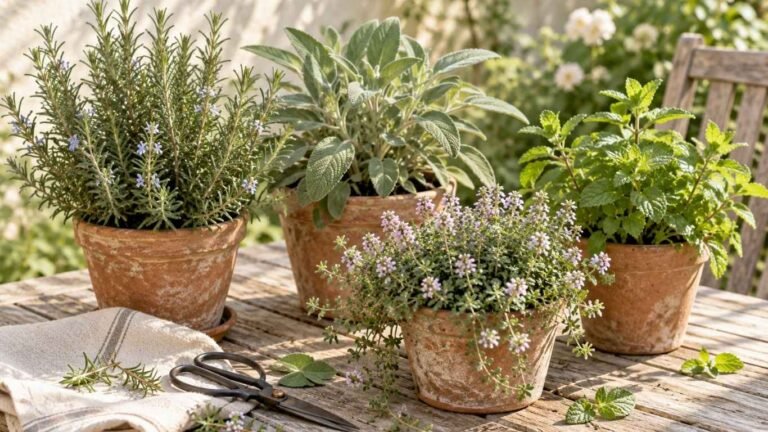
Imagine a weathered terracotta pot filled with silvery-green foliage. On a mild autumn afternoon, brushing a hand lightly against the herbs releases a familiar, comforting fragrance.
Rosemary and thyme are particularly lovely together because they share a preference for sunshine and free-draining compost.
Your planting recipe
Container: Approximately 35–40 cm wide, with drainage holes.
Ingredients:
- 1 young upright rosemary plant (Salvia rosmarinus)
- 2 small creeping thyme plants (Thymus species or cultivars)
- Peat-free potting compost with added horticultural grit
- A little gravel for an optional decorative top-dressing
How to arrange it
Place the rosemary slightly towards the back of the container to provide height and structure.
Position the thyme towards the front, allowing its stems to soften the edge of the pot as they grow.
Keep the rootballs comfortably spaced, rather than crowding everything together. Both herbs will become larger with time.
Set the container in a sunny position, preferably near a sheltered wall, where you can enjoy the scent when you touch or brush past the foliage.
The fragrance: Resinous, herbal, slightly woody and wonderfully fresh.
Best season: Aromatic foliage can be enjoyed through much of the year, although plants may need protection from prolonged cold and winter wet.
A little gardening wisdom: Rosemary dislikes sitting in wet compost. In colder or wetter areas of the UK, particularly exposed northern gardens, protect the container from heavy winter rain and freezing conditions.
Journal prompt: Which garden fragrance instantly reminds you of a place you love? Could you recreate a little of that memory in a pot?
Scent Recipe No. 2: The Woodland Winter Welcome
For a partially shaded doorstep, courtyard or a corner close to the house.
Autumn doesn’t have to mean the end of garden fragrance.
One of the loveliest ways to extend the scented year is to plan for winter now.
Sweet box (Sarcococca) is an evergreen shrub with glossy leaves and small, wonderfully fragrant winter flowers.
Its appearance is understated, but its perfume can be extraordinary.
For a beautiful autumn-to-winter arrangement, I would create a small group of coordinating pots, rather than squeeze several plants with different growing needs into one container.
Your planting recipe
Container arrangement:
- 1 generous pot, approximately 40–45 cm wide, for a young sweet box (Sarcococca confusa)
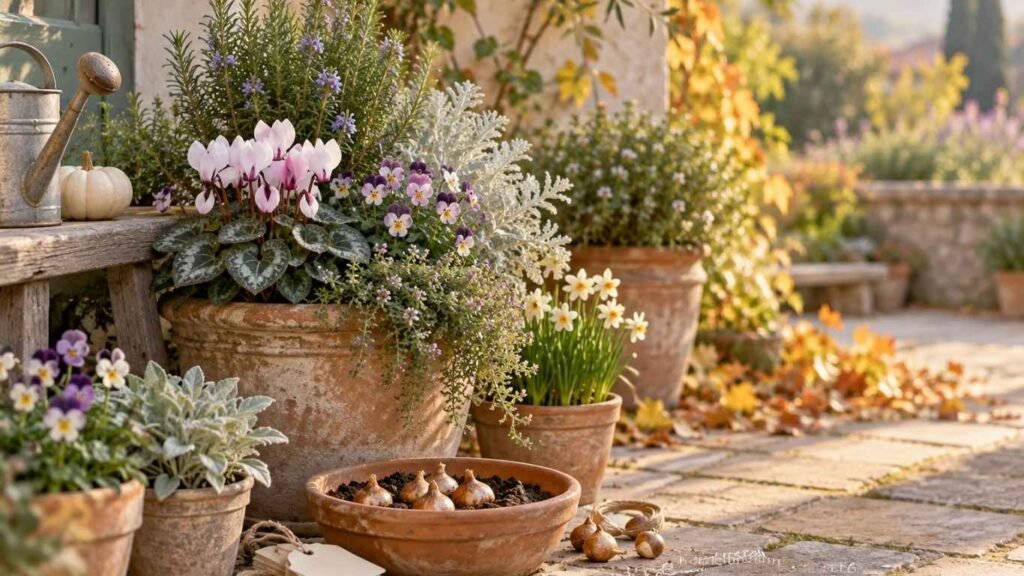
- 1 smaller pot of hardy autumn cyclamen (Cyclamen hederifolium)
- 1 smaller pot of autumn violas for colour
Choose a position with partial shade and shelter from drying winds.
The cyclamen contributes delicate pink flowers and beautifully patterned leaves. Some hardy cyclamen have fragrance, but treat their autumn display primarily as a visual pleasure.
The violas add colour as the garden settles towards winter.
And then, during the colder months, the sweet box takes its turn.
The fragrance: Sweet, rich and floral, strongest when sweet box comes into bloom in winter.
Best season: Autumn colour followed by winter fragrance.
Important: Sweet box is a shrub that will eventually require a generous container and periodic repotting. The other plants are best kept in their own pots so their watering requirements can be managed individually.
There’s something quietly luxurious about a plant that perfumes the air when so little else is flowering.
Scent Recipe No. 3: The Scented Bulb Lasagne
One pot. Several layers. A succession of spring flowers.
If you’ve never planted a bulb lasagne before, autumn is the perfect time to discover it.
The idea is wonderfully simple.
Instead of planting just one type of spring bulb, you arrange different bulbs in layers within a deep container.
The larger or later-flowering bulbs sit lower down, while smaller, early-flowering bulbs are positioned nearer the top.
As spring arrives, the flowers emerge in succession.
Think of it as creating a little spring garden inside a single pot.
And when you choose fragrant varieties, the experience becomes even more delightful.
Which spring bulbs actually smell beautiful?
Not every spring bulb has a strong perfume, so it’s worth being selective.
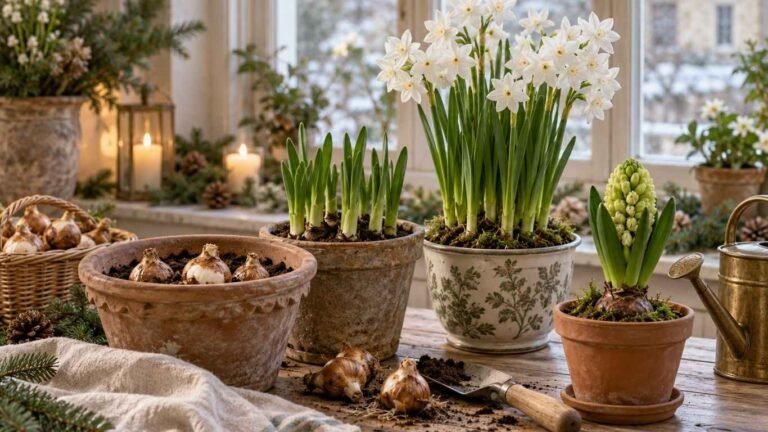
Hyacinths are among the most reliable choices for a rich, sweet spring fragrance.
Fragrant narcissus, such as Narcissus ‘Geranium’, offer beautiful white flowers with orange-red cups and a sweet floral scent.
Tulips provide height, colour and a later display. Some cultivars are scented, but many are grown chiefly for their appearance.
Crocuses are particularly valuable for early colour, even when fragrance is not their main attraction.
The trick is to combine fragrant stars with supporting flowers that make the whole display beautiful.
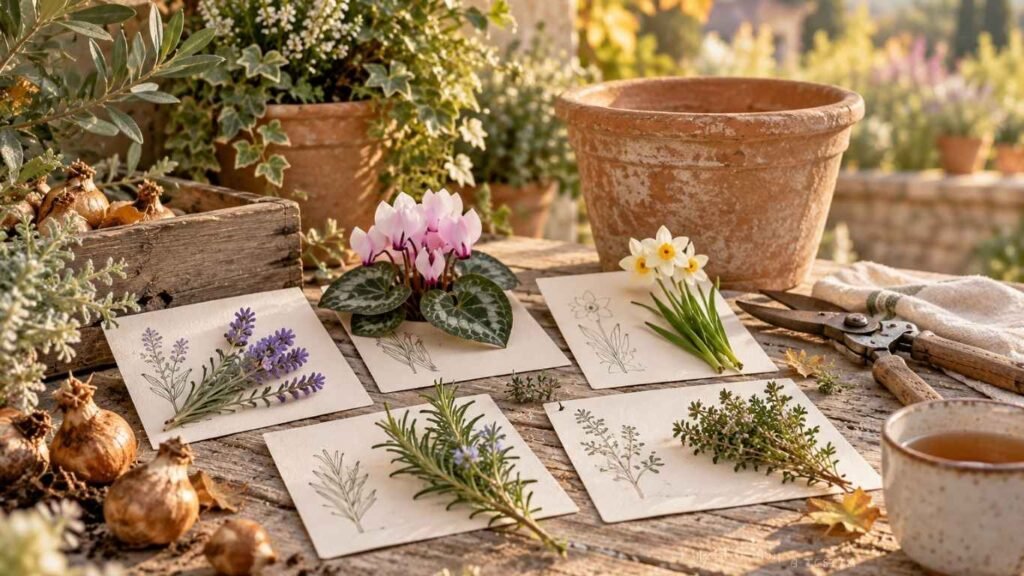
Two Scented Bulb Lasagne Recipe Cards to Try
These recipes are designed as starting points for a deep pot approximately 35–40 cm wide. Adjust quantities according to the size of your bulbs and container, keeping bulbs close but not touching.
Recipe Card 01: The Spring Perfume
Scent family: Sweet floral
Colour palette: Lavender-blue, soft yellow and apricot
Container: Deep terracotta or frost-resistant outdoor pot
Planting layers, from bottom to top:
| Layer | Bulbs | Purpose |
|---|---|---|
| Bottom | 5 tulips, such as ‘Apricot Beauty’ | Later spring colour |
| Middle | 4 fragrant hyacinths, such as ‘Delft Blue’ | The main spring perfume |
| Top | 8–10 early crocuses | Early flowers and colour |
Expected display: Typically late winter or early spring through mid-to-late spring, depending on variety, weather and location.
Fragrance highlight: Sweet hyacinth.
Best position: Sunny to lightly shaded, with good drainage.
The finishing touch: A few winter-flowering violas can be added carefully to the surface for immediate colour, provided they do not crowd the emerging bulbs.
Recipe Card 02: The Gentle Morning
Scent family: Fresh, soft floral
Colour palette: Cream, white, pale pink and silver
Container: Deep frost-resistant pot, approximately 40 cm wide
Planting layers, from bottom to top:
| Layer | Bulbs | Purpose |
|---|---|---|
| Bottom | 5 fragrant narcissus ‘Geranium’ | Later spring fragrance |
| Middle | 4 white hyacinths ‘Carnegie’ | Rich spring scent |
| Top | 8–10 early white crocuses | Early spring colour |
Expected display: A succession of flowers through spring, with the exact timing varying according to the weather.
Fragrance highlight: Hyacinth followed or accompanied by sweetly scented narcissus, depending on flowering times.
Best position: A bright, reasonably sheltered spot near a doorway or path.
The finishing touch: Choose a simple cream or aged terracotta pot to complement the soft planting palette.
How to Plant Your Bulb Lasagne
- Choose a deep container. Aim for at least 30 cm in width and depth, preferably larger for a three-layer recipe. Ensure it has good drainage holes.
- Prepare your compost. Use peat-free multi-purpose compost, with horticultural grit added where extra drainage is needed.
- Plant the lowest layer. Add a generous base of compost and arrange the bulbs pointed-end upwards. Follow the recommended depth for the largest bulbs.
- Add the next layer. Cover the first bulbs with compost, then position the next group between the bulbs below where possible, leaving enough room for their roots and growth.
- Finish with the smallest bulbs. Cover the final layer with compost to the correct depth, leaving room below the rim for watering.
- Water after planting. Let excess water drain away, then keep the pot outdoors in a suitable sheltered location. Avoid leaving it in saturated compost over winter.
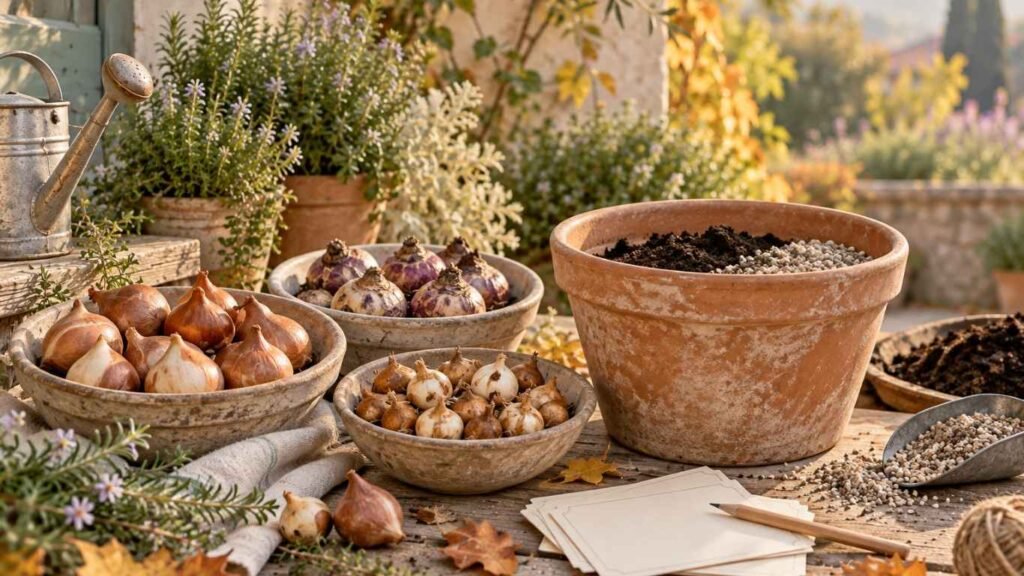
- Record your recipe. Write down the bulb varieties, quantities, planting date and expected flowering periods.
The RHS has an excellent guide to layering bulbs in pots if you’d like additional planting guidance.
When should you plant bulbs in the UK?
For most spring-flowering bulbs, early autumn is ideal.
Daffodils, crocuses and hyacinths are best planted earlier in the season, often around September. Tulips are generally best planted later, particularly in November.
If you’re putting together a mixed bulb lasagne in October, choose fresh, firm bulbs and plant without unnecessary delay. The non-tulip bulbs may already be past their ideal planting window.
For the most reliable results, you can also create separate pots for early bulbs and November-planted tulips, then group them together in spring.
And remember that flowering dates can differ significantly between Cornwall, Yorkshire and the Scottish Highlands.
A little flexibility is part of gardening.
The Evening Scent 5-Pot Plan: Create a Fragrant Retreat for Next Summer
Now for a particularly lovely project.
Imagine a warm evening next year.
The day’s gardening is finished. There’s a comfortable chair, perhaps a soft linen cushion, a favourite book and a cup of tea.
As the light begins to fade, the flowers around you release their fragrance.
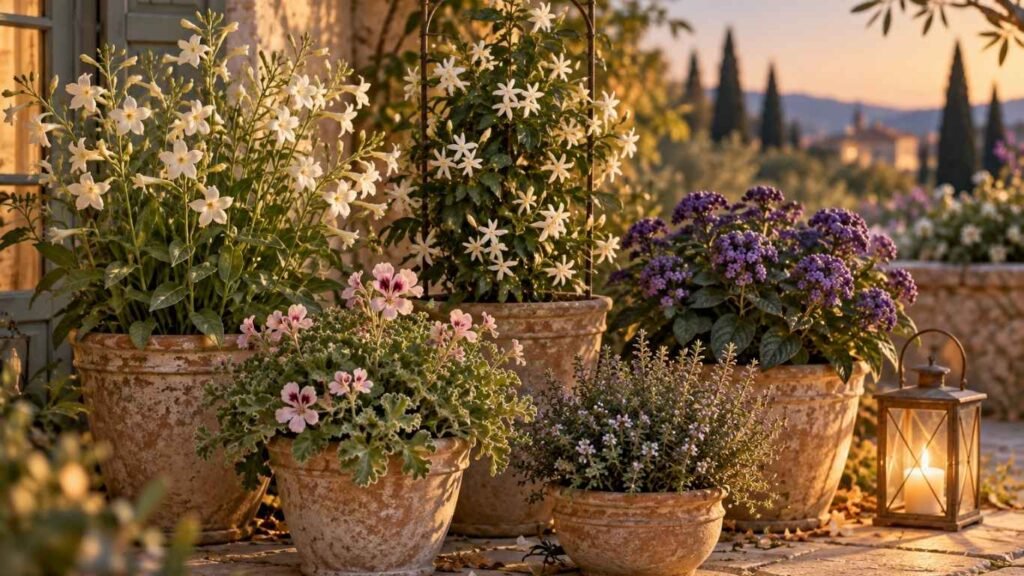
You don’t need a rose garden or an elaborate pergola to enjoy this. Five carefully positioned pots can make a surprisingly beautiful scented corner.
Autumn is the ideal time to plan the layout, save ideas and decide which plants to grow next spring.
Some existing summer plants may continue flowering into early autumn in mild parts of the UK, but several of the plants below are tender and should not be treated as reliable winter displays.
Your Five Pots
Pot 1: Star Jasmine — The Fragrant Backdrop
Plant: Trachelospermum jasminoides
Container: Approximately 45–50 cm wide, with a sturdy support
Position: Sunny, warm and sheltered
Fragrance: Rich, sweet and jasmine-like
Main flowering season: Summer
Place this container towards the back of your arrangement, against a wall or trellis.
Star jasmine provides beautiful evergreen foliage and deliciously perfumed white flowers in summer.
In colder UK gardens, especially exposed locations, container-grown plants may need winter protection.
Allow it plenty of room to grow, and remember that this is the structural anchor of your little scented retreat.
Pot 2: Nicotiana — The Evening Performer
Plant: Fragrant Nicotiana alata
Container: Approximately 35–40 cm wide, with enough stability for taller stems
Position: Sun or light shade, sheltered from strong wind
Fragrance: Sweet and noticeably stronger in the evening
Main flowering season: Summer into early autumn
Nicotiana is a wonderful choice for people who enjoy sitting outside as daylight fades.
Look for fragrant species and varieties rather than assuming every modern bedding nicotiana will have a strong perfume.
Grow from seed in spring or buy young plants, placing them outdoors after the danger of frost has passed.
Position this pot behind or beside your chair, where the fragrance can drift towards you on a still evening.
Pot 3: Heliotrope — The Sweetheart of the Collection
Plant: Heliotropium arborescens, such as ‘Marine’
Container: Approximately 30–35 cm wide
Position: Sunny and sheltered
Fragrance: Sweet, often described as vanilla or cherry-pie-like
Main flowering season: Summer until cold weather brings flowering to an end
Heliotrope brings a romantic softness to a container arrangement.
Its clusters of purple-blue flowers look beautiful against sage-green foliage and weathered terracotta.
Grow it as a summer bedding plant or overwinter it in suitable frost-free conditions.
Place it close enough to the seating area to appreciate its perfume.
Pot 4: Rose-Scented Pelargonium — The Interactive Scent
Plant: A scented-leaf pelargonium, such as ‘Attar of Roses’
Container: Approximately 30–35 cm wide
Position: Warm, sunny and sheltered
Fragrance: Rose-like, released mainly when the foliage is touched
Best season: From late spring into autumn outdoors, before frost
Not every garden scent has to come from a flower.
The softly textured foliage of scented pelargoniums can be one of the most enjoyable elements in a small sensory garden.
Position this pot beside your favourite chair or a path where the foliage is easy to brush lightly.
As the weather cools, move the plant into a light, frost-free place.
Pot 5: Night-Scented Stock — The Finishing Touch
Plant: Matthiola longipetala subsp. bicornis
Container: Approximately 25–30 cm wide
Position: Sunny and sheltered
Fragrance: Sweet, especially after dusk
Main flowering season: Summer, depending on sowing date
Night-scented stock is not necessarily the showiest flower during the day.
And that is precisely why it can be so delightful.
Its delicate blooms become much more interesting when evening arrives and their fragrance develops.
Sow it in spring in a free-draining container, following the seed packet directions.
Try placing this pot nearest the edge of the seating area.
How to Arrange the Five Pots
You don’t need to line the pots up in a neat row.
Instead, imagine creating a small fragrant embrace around your favourite outdoor seat.
Place the star jasmine against the back wall, with nicotiana slightly to one side.
Position the heliotrope in front to add a soft mound of flowers.
Keep the rose-scented pelargonium close to your chair, where you can enjoy its aromatic foliage.
Finally, tuck the night-scented stock near the front.
The result should feel relaxed, layered and inviting rather than formal.
A practical detail: Each plant remains in its own pot. This allows you to adjust watering, move plants for winter protection and replace seasonal flowers without disturbing the whole arrangement.
What about fragrance in autumn and winter?
Don’t be disappointed when the summer flowers finish.
Use autumn to move frost-sensitive plants under cover, refresh evergreen pots and plan the next season.
For a more dependable winter fragrance, introduce a separate container of sweet box near the doorway or somewhere sheltered.
Keep rosemary or thyme in a sunny position for aromatic foliage.
Your evening garden becomes a year-round project, even though its strongest floral display belongs to summer.
The Scent Journal: A Beautiful Way to Garden More Intentionally
One of the most enjoyable things about a fragrant garden is that no two seasons are quite the same.
A flower that seemed wonderfully scented one year may be less noticeable in another.
A plant may bloom earlier after a mild winter, or a warm evening may reveal a fragrance you barely noticed during the day.
This is where a garden journal becomes genuinely useful.
Instead of recording only what you planted, try recording what you experienced.
Five Things to Write Down
1. The date and weather
Was the evening warm or cool? Had it rained? Was there a gentle breeze?
2. The strongest fragrance
Which plant did you notice first? Was the scent sweet, fresh, herbal, floral or spicy?
3. The best position
Did a pot smell stronger near the wall, beside the door or next to your chair?
4. What worked
Did the plant flower for longer than expected? Did it need more watering? Was it happier in partial shade?
5. What you would change
Perhaps you’d plant more hyacinths next year, or move the nicotiana closer to your favourite seat.
Over time, these simple observations become your own personal guide to gardening with fragrance.
A Lovely Autumn Journaling Ritual
Choose one quiet evening each week.
Make a cup of tea, take your notebook outside or sit near a window overlooking the garden, and spend ten minutes looking closely at the season.
Record one thing that is changing, one fragrance you noticed and one idea you’d like to try next.
You might be surprised how much you begin to notice.
And if you enjoy keeping things organised, a digital garden planner or printable set of planting recipe cards can make it easy to build a little library of successful combinations.
A Simple Autumn Scent Checklist
Before the colder weather settles in, these are the jobs worth adding to your gardening notebook.
| When | Your garden task |
|---|---|
| September–October | Plant suitable spring-flowering bulbs promptly |
| October | Refresh autumn herb pots and check drainage |
| October | Plant suitable hardy shrubs, including sweet box |
| October–November | Finish planning spring bulb displays |
| November | Plant tulips in pots |
| Before the first frost | Move scented pelargoniums and other tender plants into suitable shelter |
| Winter | Check pots for waterlogging, protect vulnerable roots and plan next year’s evening garden |
| Spring | Start summer-flowering annuals, refresh containers and observe the first fragrant bulbs |
If you live in a particularly cold or exposed part of the UK, move frost-sensitive jobs earlier.
In milder coastal areas, you may enjoy a slightly longer outdoor season.
Always let your local weather guide the final decision.
Frequently Asked Questions
Can I create a scented garden on a small UK balcony?
Absolutely. Start with two or three containers suited to the amount of sunlight you receive. Choose a mix of fragrant foliage and flowering plants, and position them where you will encounter their scent most often. On balconies, also consider wind exposure, drainage and safe container weight.
Can I plant different bulbs in the same pot?
Yes. Layered bulb planting, sometimes called a bulb lasagne, is an excellent way to create a sequence of spring flowers in a small space. Use a deep container, suitable compost and bulbs with compatible growing conditions.
Which spring bulbs have the strongest scent?
Hyacinths are among the most famously fragrant. Certain narcissus, including ‘Geranium’, also have a lovely perfume. If scent is important to you, check the specific variety rather than assuming all bulbs are fragrant.
What is the best plant for an evening-scented patio?
For a summer patio, fragrant nicotiana and night-scented stock are excellent options because their perfume becomes especially noticeable towards evening. Star jasmine offers strongly scented summer flowers on a sheltered support.
Can I create an evening-scented garden in autumn?
You can certainly plan one in autumn, and you may still enjoy late flowers before the first frost. However, most classic evening-scented annuals are summer performers. For fragrance through winter, try hardy winter-flowering shrubs such as sweet box, together with aromatic evergreen herbs where conditions suit them.
Are fragrant bulbs and plants safe around pets?
Not all of them. Daffodil and hyacinth bulbs can be harmful if eaten, and certain other ornamental plants may also pose risks. Wear gloves when handling bulbs, keep them away from children and pets, and check plant-specific safety information before buying.
A Fragrant Garden Begins With One Thoughtful Pot
It is tempting to believe that a beautiful garden requires endless space, expensive plants or hours of maintenance.
But some of the most rewarding gardening moments are surprisingly simple.
The scent of rosemary on a cool autumn afternoon.
A pot of hyacinths coming into flower after a long winter.
The soft fragrance of nicotiana drifting across a patio on a summer evening.
Each begins with a little planning.
So this autumn, rather than filling every available container, choose one corner of your outdoor space and imagine how you would like it to feel.
Fresh and herbal?
Soft and romantic?
Sweetly scented as evening falls?
Choose a scent, find a suitable pot and begin there.
Because the most beautiful garden isn’t always the one with the most flowers.
Sometimes, it’s the one that makes you want to stay outside just a little longer.
Make Your Scent Garden Personal
Turn your favourite planting ideas into a collection of seasonal recipe cards. Record the plants you choose, sketch your containers, note flowering times and keep a little space for the scents that make each season memorable.
For more planting inspiration, explore Scented Garden’s beginner-friendly guides and the free 12-Month Scent Calendar introduced there.
Create a garden that smells as beautiful as it looks.
Further Reading & Gardening Guidance
The planting advice in this article draws on the Royal Horticultural Society’s guidance:
- How to Plant Bulbs in a Pot
- Choosing and Planting Bulbs in Autumn
- Fragrant Plants
- How to Grow Sarcococca
- How to Grow Trachelospermum
- Scented-Leaf Pelargoniums
Planting and flowering times are approximate and should be adjusted for UK location, aspect and seasonal conditions.