How to Create a Scented Garden: A Beginner’s Guide
In short: A scented garden is planned around what you smell, where you sit and when you are outside. Five decisions get you there: your space, your light, the scent family you love, the season and time of day you use the space, and how much work you want. Start with 3 to 5 pots placed within arm’s reach of a door or a seat, and add one plant for each season so that something is in scent all 12 months.
Most gardens are planned by colour and then smell of nothing by July. This guide shows you how to create a scented garden that greets you at the door and keeps you outside for ten more minutes in the evening. The order of your decisions matters more than the size of your space.
This guide is for a balcony, a patio, a doorstep or a small garden. You do not need experience. You will finish with a short plant list, a place for each pot and a plan for the whole year.
Table of Contents
What makes a garden scented
A scented garden is chosen by nose first. Colour, height and flowering time still matter, but they come second.
Scent reaches you in three different ways, and a good small garden uses all three.
- Flowers that fill the air. Hyacinths, sweet peas and roses send scent out on their own. You smell them before you see them.
- Leaves that answer when you touch them. Cambridge University Botanic Garden notes that plants such as lavender, mint and thyme release scent when they are disturbed, and also in rain and in hot weather. These are the plants to put where your hand or your sleeve will brush them.
- Evening scent. Some plants save their fragrance for dusk. The same garden explains that common jasmine scents its flowers in the evening to attract hawk moths. If you are only outside after work, these plants matter most.
Plants do not make scent for us. Fragrance is a tool for attracting pollinators or putting off predators. That is useful to know, because it tells you when a plant will smell: when its pollinator is flying, or when its leaves are warm or bruised.
How to create a scented garden in five decisions
Work through these in order. Each answer shortens your plant list, which is the point. A short list is easier to buy, easier to place and easier to keep alive.
1. Your space
Write down what you really have. A balcony rail and three pots. A paved patio with one sunny wall. A front step. A small border beside a path.
Small is an advantage here. Scent thins out quickly in open air, so a tight, enclosed space holds it better than a large lawn. Cambridge University Botanic Garden built its Scented Garden in a slight hollow for exactly this reason: to trap fragrance. A balcony with a solid screen, a corner between two walls or a doorway does the same job at home.
2. Your light
Count the hours of direct sun in summer. Six or more is a sunny spot. Three to six is part shade. Fewer than three is shade.
This one decision removes more plants than any other. Lavender, rosemary, thyme, lemon verbena and scented pelargoniums are sun plants. The Royal Horticultural Society (RHS) says of scented-leaf pelargoniums that a position in full sun helps develop the aromatic oils, and the same is true in practice for the Mediterranean herbs. In shade they survive for a while and smell of very little.
If your space is shady, lean on spring bulbs and winter shrubs instead. Hyacinths prefer full sun but, according to the RHS, will tolerate partial shade for a one-off display.
3. The scent you love
Choose one scent family to lead and one to support. Two is enough for a small space. The charity Thrive, which uses gardening to support people’s wellbeing, puts it simply: less is often more when it comes to scent.
The table in the next section lists the eight families we use across this site.
4. When you are outside
Be honest about this. If you leave at seven in the morning and come home at six, a plant that smells best at midday is wasted on you. Choose for the hours and the months you are really there.
- Morning coffee on the step: herbs you can pinch, such as rosemary and thyme.
- Hot afternoons: lavender and other aromatic leaves, which release scent in heat.
- Evenings: night phlox, jasmine and other evening-scented flowers.
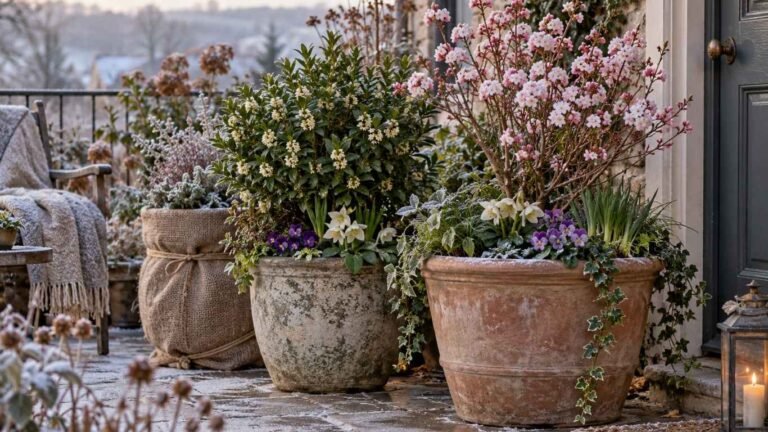
- Winter, passing through: one scented shrub or a pot of bulbs right beside the door.
5. How much work you want
Sort your shortlist into three groups before you buy anything.
- Low effort: hardy and permanent. English lavender, rosemary, thyme, pinks, sweet box.
- Medium effort: tender plants that need a frost-free place in winter. Lemon verbena, scented pelargoniums.
- Seasonal effort: plants you start again every year. Sweet peas, night phlox, pots of bulbs.
A first scented garden works well with three low-effort plants, one tender plant you are happy to carry indoors, and one seasonal treat.
Choose your scent family
Garden scents fall into loose families, much as perfumes do. Naming them makes choosing easier, and it stops you buying five plants that all smell of the same thing.
| Scent family | What it smells like | Plants to start with |
|---|---|---|
| Floral | Soft, sweet, petal-like | Rose, sweet pea, lilac, jasmine |
| Herbal | Green, resinous, clean | Rosemary, thyme, sage, lavender |
| Citrus | Sharp, bright, lemony | Lemon verbena, lemon balm, lemon-scented pelargonium |
| Sweet | Honey, vanilla, almond | Heliotrope, sweet alyssum, honeysuckle |
| Spiced | Clove and warm spice | Garden pinks and other clove-scented dianthus |
| Woodland | Cool, mossy, hay-like | Sweet woodruff, aromatic foliage |
| Mediterranean | Sun-warmed, dry hillside | Lavender, rosemary, santolina, thyme |
| Night fragrance | Heavy, sweet, strongest at dusk | Nicotiana, jasmine, night phlox |
A quick way to choose. Think of a smell that makes you stop walking. A lemon being cut means citrus. A herb stall at a market means herbal or Mediterranean. Your grandmother’s flower border is probably floral or spiced. Lead with that family and add one more for contrast.
Where to put scented plants so you actually smell them
Placement decides whether you notice a plant every day or twice a year. These six rules come from gardens that are designed for scent, and all of them work on a balcony.
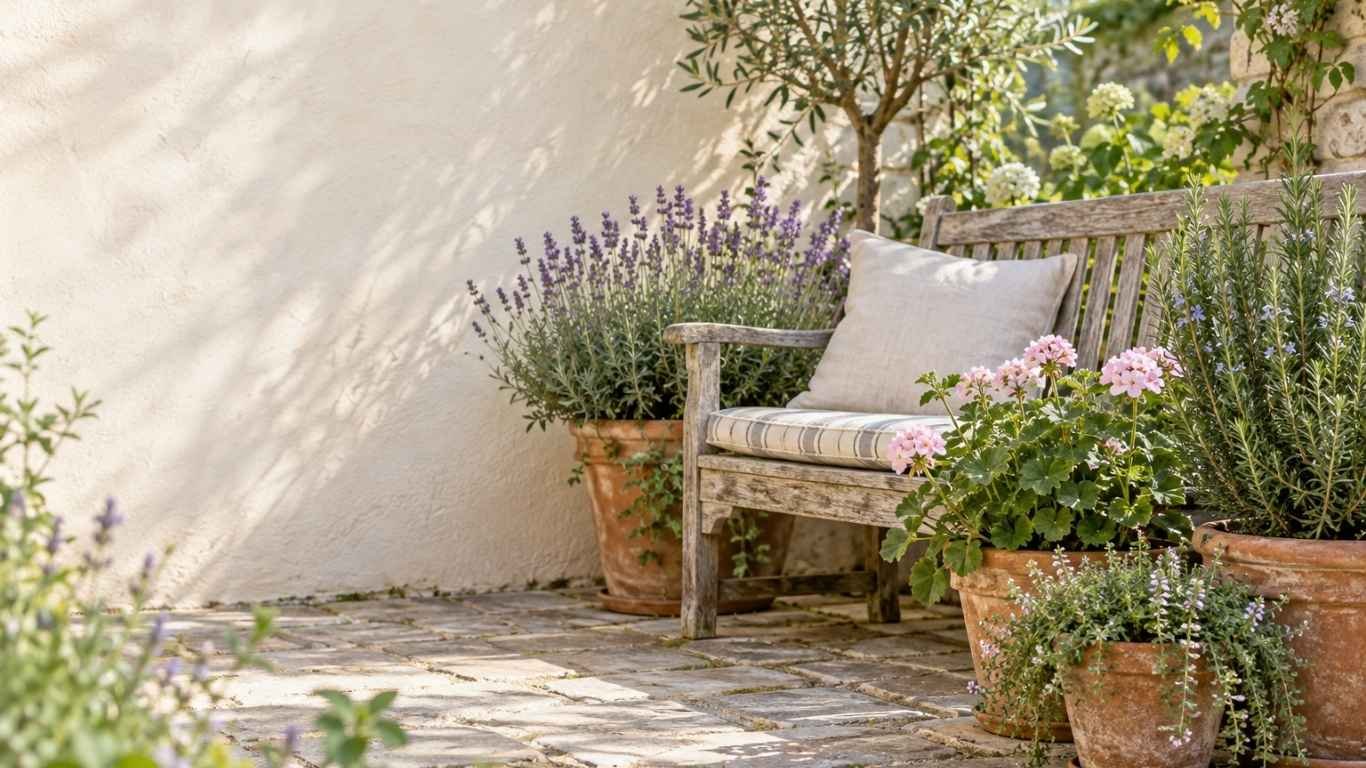
- Put scent where you already stop. Cambridge University Botanic Garden advises planting fragrant plants around patios, doorways or seating areas, where the fragrance can be easily enjoyed. The RHS suggests a pot on either side of the front door, so that you get a fragrant greeting every time you brush past.
- Use shelter. Thrive points out that a sheltered area helps to contain fragrance. A corner, a wall or a screen keeps scent from blowing away.
- Bring plants up to your nose. The Scented Garden in Cambridge uses raised beds so that visitors can enjoy the plants at close hand. At home, that means a pot on a table, a shelf, a wall bracket or the top step.
- Put touch-scented plants in the way. Thyme at the edge of a path, a scented pelargonium by the door handle, rosemary beside the chair arm. Thrive suggests keeping smaller scented plants at the front so that you enjoy them as you pass.
- Keep strong scents apart. Give different scents some distance from each other so that they do not compete. One plant per corner is plenty in a small space.
- Put winter scent by the door or a window. You will not sit outside in January, but you will walk past. Thrive recommends placing winter-flowering shrubs close to a door or window for this reason.
Ten starter plants for a small scented garden
These ten cover every season, five scent families and all three effort levels. All of them grow in pots. Pick five.
| Plant | Scent family | Light | Pot | When it smells | Effort |
|---|---|---|---|---|---|
| English lavender | Herbal, Mediterranean | Full sun | 30–40 cm (12–16 in) wide | Flowers in summer, leaves all year | Low |
| Rosemary | Herbal, Mediterranean | Full sun | At least 30 cm (12 in) wide and deep | Leaves all year, when touched | Low |
| Thyme | Herbal | Full sun | At least 15 cm (6 in) wide, 10 cm (4 in) deep | Leaves all year, flowers in summer | Low |
| Garden pinks | Spiced | Full sun | A medium pot with sharp drainage | Early to midsummer | Low |
| Lemon verbena | Citrus | Full sun, sheltered | A generous pot you can still lift | Leaves from late spring to autumn, when touched | Medium |
| Scented pelargonium | Citrus, floral or mint, by variety | Full sun | A generous pot with added grit | Leaves whenever rubbed, best in heat | Medium |
| Sweet peas | Floral | Sun, light dappled shade is fine | A deep pot with supports | Summer | Seasonal |
| Hyacinths | Floral, sweet | Full sun, part shade for one season | At least 3 to 5 bulbs to a pot | March and April | Seasonal |
| Night phlox | Night fragrance | A warm, open spot | A small pot near the seat or door | Summer evenings | Seasonal |
| Sweet box | Sweet | Out of strong sun | A large pot by the door | Midwinter | Low |
English lavender (Lavandula angustifolia)
The backbone of a sunny scented space. The RHS describes English lavenders as the hardiest types. The variety ‘Hidcote’ is rated hardy to between −15 and −10°C (5 to 14°F) and stays compact at up to 50 cm (20 in) tall. Thrive notes that lavender is scented all year round, because the leaves carry scent as well as the flowers.
It needs a pot 30–40 cm (12–16 in) wide with large drainage holes, gritty compost and no feeding. Most lavender that dies in a pot dies of wet roots. We cover that in detail in lavender in pots: why it dies and how to grow it successfully.
Rosemary (Salvia rosmarinus)
Evergreen, useful in the kitchen and scented every time you pass. The RHS recommends a pot at least 30 cm (12 in) wide and deep, with soil-based compost and up to 25 per cent grit. Rosemary survives temperatures down to about −8°C (18°F), so in a cold-winter climate a potted plant needs a sheltered wall and some wrapping in hard frost.
Thyme (Thymus)
The smallest pot on the list and the best plant for the edge of a step. One plant is happy in a pot 15 cm (6 in) wide and 10 cm (4 in) deep. It wants sun and sharp drainage and dislikes damp, especially in winter. In summer it carries tiny pink, mauve or white flowers that are rich in nectar.
Garden pinks (Dianthus)
The scent of cloves in early summer. The old variety ‘Mrs Sinkins’ has white, fringed, double flowers with a strong, rich clove scent in early and midsummer. It is rated hardy to between −20 and −15°C (−4 to 5°F), and the RHS lists it as suitable for patio and container growing. Give it full sun and well-drained soil.
Lemon verbena (Aloysia citrodora)
The strongest lemon scent you can grow. It is a deciduous shrub with narrow, strongly lemon-scented leaves, and it wants full sun and a sheltered position. The catch is cold: the RHS rates it hardy only to between −5 and 1°C (23 to 34°F). In a pot you can carry it under cover for the winter, which is why it sits in the medium-effort group.
Scented pelargoniums (Pelargonium)
Grown for their leaves, which release fragrance when rubbed. The RHS lists ‘Attar of Roses’ for rose scent, Pelargonium tomentosum for peppermint and Pelargonium crispum ‘Variegatum’ for lemon. They want full sun and compost opened up with grit, and they will not take frost. Keep one beside the door, where your hand finds it.
Sweet peas (Lathyrus odoratus)
The classic floral scent of summer. Most climbing varieties reach about 2 m (6½ ft) and need canes or netting. Sow in October or November, or from late January to April, and plant out in April. The one rule that matters: pick the flowers as often as you can. The RHS warns that sweet peas stop flowering if seedpods are allowed to develop.
Hyacinths (Hyacinthus orientalis)
Scent in March and April, when almost nothing else is out. Plant the bulbs in early autumn, 10 cm (4 in) deep, with at least three to five in a container for a bold display. A pot by the front door is enough to scent a whole entrance.
Night phlox (Zaluzianskya)
Small white flowers through summer, grown for one thing: the RHS says the fragrance is strongest in the evening, after around 7pm, and describes it as vanilla to some noses and fresh washing to others. One pot beside the chair you sit in after work is all you need.
Sweet box (Sarcococca confusa)
An evergreen shrub with small cream-white flowers that, in the words of Cambridge University Botanic Garden, bring fragrance in the New Year. It is the answer to the question “what smells good in January?” Keep it in a large pot beside the door you use most.
Plan your scented garden through the year
The most common first mistake is buying everything in May. The result is three glorious weeks in June and nothing for the other eleven months. A scented garden works best when fragrance is staggered across the year, so plan one plant for each season before you add a second for summer.
| Season | In scent | What to do now |
|---|---|---|
| Winter | Sweet box, daphne, wintersweet; evergreen rosemary and bay when touched | Keep one scented pot by the door. Protect pots from wet and hard frost. |
| Spring | Hyacinths in March and April; wallflowers | Enjoy the bulbs. Sow sweet peas until April. |
| Summer | Lavender, pinks, sweet peas, roses, jasmine, night phlox; all the scented leaves | Pick sweet peas often. Trim lavender when flowering ends. |
| Autumn | Rosemary, thyme, sage and lemon verbena leaves until frost | Plant bulbs. Bring tender plants under cover before the first frost. |
These months describe a Central European garden like ours, with cold winters and hot, dry summers. Shift everything by your own last and first frost dates. If your spring comes three weeks later, so do your hyacinths.
Two plans you can copy
The sunny balcony: five pots, herbal and spiced
For a balcony or patio with six hours of sun or more.
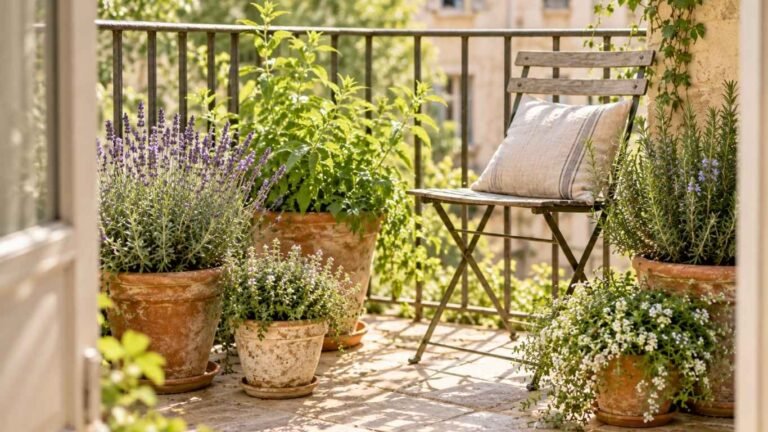
- 1 rosemary in a 30 cm (12 in) pot, at the back, beside the chair
- 1 English lavender in a 30–40 cm (12–16 in) pot, in the sunniest corner
- 1 thyme in a small pot on the table or the top step
- 1 scented pelargonium by the door, where your hand passes
- 1 pot of garden pinks at the front, for clove scent in early summer
All five want the same things: full sun, gritty compost and a light hand with the watering can. Only the pelargonium needs to come indoors for winter.
The doorstep: scent in every season
For a front or back door you use every day.
- Winter: sweet box in a large pot, permanently beside the door
- Spring: a pot of hyacinths, planted in early autumn
- Summer: a pot of sweet peas on a wigwam of canes, or night phlox if you come home late
- All year: a pot of thyme or rosemary to pinch as you leave
Swap the seasonal pot in and out. The permanent pots stay where they are.
Care basics that keep the scent coming
Scented plants are not difficult, but most of them come from dry, sunny places and they fail in the same few ways.
- Drainage first. For lavender, rosemary and thyme the RHS recommends mixing coarse grit into the compost, up to 25 per cent by volume, and using pots with plenty of drainage holes.
- Sun makes scent. Aromatic oils develop best in full sun. A plant moved into shade will often live and stop smelling.
- Feed lightly or not at all. Lavender does not generally need feeding. Sweet peas in pots are the exception and need regular feeding to keep flowering.
- Trim after flowering. Lavender, rosemary and thyme stay compact if you trim them lightly once the flowers fade. Never cut back into old, bare wood.
- Protect pots in winter. Roots in a pot are more exposed than roots in the ground. The RHS advises keeping containers in dry, sheltered places, grouped together, and wrapping them to stop the roots freezing.
- Carry tender plants indoors. Lemon verbena and scented pelargoniums need a frost-free winter. Our guide to overwintering herbs and scented plants helps you decide which ones are worth the space.
A ten-minute evening habit
A scented garden earns its keep when you use it. Ten minutes is enough.
Take a cup of tea outside after work. Pinch the rosemary. Run a hand over the thyme. Deadhead three sweet peas. Notice what smells different from yesterday.
Many people find a small routine like this calming, and regular contact with a garden is linked with feeling better in general. In a study of 5,766 gardeners run by the RHS with the Universities of Sheffield and Virginia, people who gardened every day reported wellbeing scores 6.6 per cent higher and stress levels 4.2 per cent lower than people who did not garden at all. That is a finding about a large group, not a promise for any one person. It is still a good reason to go outside.
When the season ends, the scent does not have to. Dried lavender, herb bundles and saved seed carry it indoors, and we show how in gifts from the garden.
Five mistakes to avoid in your first scented garden
- Too many scents at once. Three strong plants in one corner cancel each other out. Lead with one family.
- Everything flowers in June. Buy one plant per season first.
- Scent at the far end. If you have to walk to it, you will not smell it daily. Bring it to the door or the seat.
- Wet feet. Mediterranean herbs die of soggy compost far more often than of cold.
- Cutting into old wood. Lavender and rosemary rarely regrow from bare stems. Trim lightly, every year.
Pets and children
Several favourite scented plants are not safe to eat. The ASPCA lists lavender, pelargoniums (often sold as geraniums), lemon verbena, mint and hyacinths as toxic to dogs and cats if eaten, with vomiting among the signs. It lists rosemary as non-toxic. If you have a pet that chews plants, or small children, check each plant in the ASPCA plant database before you buy, and keep bulbs and tender leaves out of reach.
Frequently asked questions
What is a scented garden?
A scented garden is one where plants are chosen and placed for fragrance first. It combines flowers that scent the air, leaves that release scent when touched, and plants that smell strongest in the evening. It can be as small as three pots by a door.
How do I start a scented garden as a beginner?
Start with three to five pots in your sunniest spot, close to a door or a seat. Choose three easy, hardy plants such as lavender, rosemary and thyme, then add one seasonal plant such as hyacinths or sweet peas. Add more only after a full year.
Which scented plants grow well in pots?
Lavender, rosemary, thyme, garden pinks, scented pelargoniums, lemon verbena, sweet peas and hyacinths all grow in containers. Lavender needs a pot 30–40 cm (12–16 in) wide and rosemary at least 30 cm (12 in) wide and deep. Thyme manages in a pot only 15 cm (6 in) across.
Where should I place scented plants?
Place them where you already stop or pass: beside doors, along paths and next to seats. Sheltered corners hold scent better than open ground. Raise small plants to hand or nose height on steps, tables and shelves.
What smells good in a garden in winter?
Sweet box flowers around the New Year and daphne and wintersweet also scent the cold months. Evergreen rosemary and bay smell whenever you touch them. Put winter scent right beside a door or window, because you will only pass it briefly.
Which plants smell strongest in the evening?
Night phlox is strongest after about 7pm, and common jasmine and tobacco plants (Nicotiana) also scent the evening air. They time their fragrance for night-flying moths. One pot beside your evening seat is enough.
Can I have a scented garden on a shady balcony?
Yes, but the plant list is shorter. Most scented herbs need full sun to develop their oils. In shade, rely on spring bulbs such as hyacinths, which tolerate partial shade for one season, and on winter-flowering shrubs.
How many scented plants do I need?
Fewer than you think. Five well-placed pots scent a balcony or a doorway. Aim for one plant in scent in each season before adding more for summer.
Why does my lavender not smell very strong?
The usual causes are too little sun and rich, wet compost. Lavender develops its scent in full sun and poor, fast-draining soil. Touch helps too: the leaves release more scent when brushed or warmed.
Are scented plants safe for cats and dogs?
Not all of them. The ASPCA lists lavender, pelargoniums, lemon verbena, mint and hyacinths as toxic to cats and dogs if eaten, and lists rosemary as non-toxic. Check each plant before buying if your pet chews leaves.
How to create a scented garden this week: your next step
Make the five decisions this week: space, light, scent family, time of day, effort. Then choose one plant for the season you are in now. In autumn that means planting hyacinths for spring and finding a frost-free place for anything tender.
Tell us in the comments: which scent makes you stop walking, and where in your space could you put it?
Sources
- Cambridge University Botanic Garden: Planting for scent
- Cambridge University Botanic Garden: Scented Garden
- Thrive: How to create a scented garden
- RHS: Fragrant front garden plants for year-round scent
- RHS: How to grow lavender
- RHS: Lavandula angustifolia ‘Hidcote’
- RHS: How to grow rosemary
- RHS: How to grow thyme
- RHS: Dianthus ‘Mrs Sinkins’
- RHS: Aloysia citrodora, lemon verbena
- RHS: Scented-leaf pelargoniums
- RHS: How to grow lathyrus (sweet peas)
- RHS: How to grow hyacinths
- RHS: Preventing winter damage
- BBC Science Focus: report on the RHS gardening and wellbeing study
- ASPCA: Toxic and non-toxic plants
Last updated: 4 October 2026 · Scented Garden