Scented Geraniums Indoors: Keep Them Alive (and Smelling) Until Spring
In short: Scented geraniums are tender pelargoniums: they will not take a frost, so they spend winter indoors. Give them your brightest window, a cool room if you have one (7–10°C / 45–50°F keeps many in steady growth), and compost that dries out between waterings. Short on space? Cut the plant back to 10 cm (4 in), or keep only a few 5–10 cm cuttings on the windowsill.
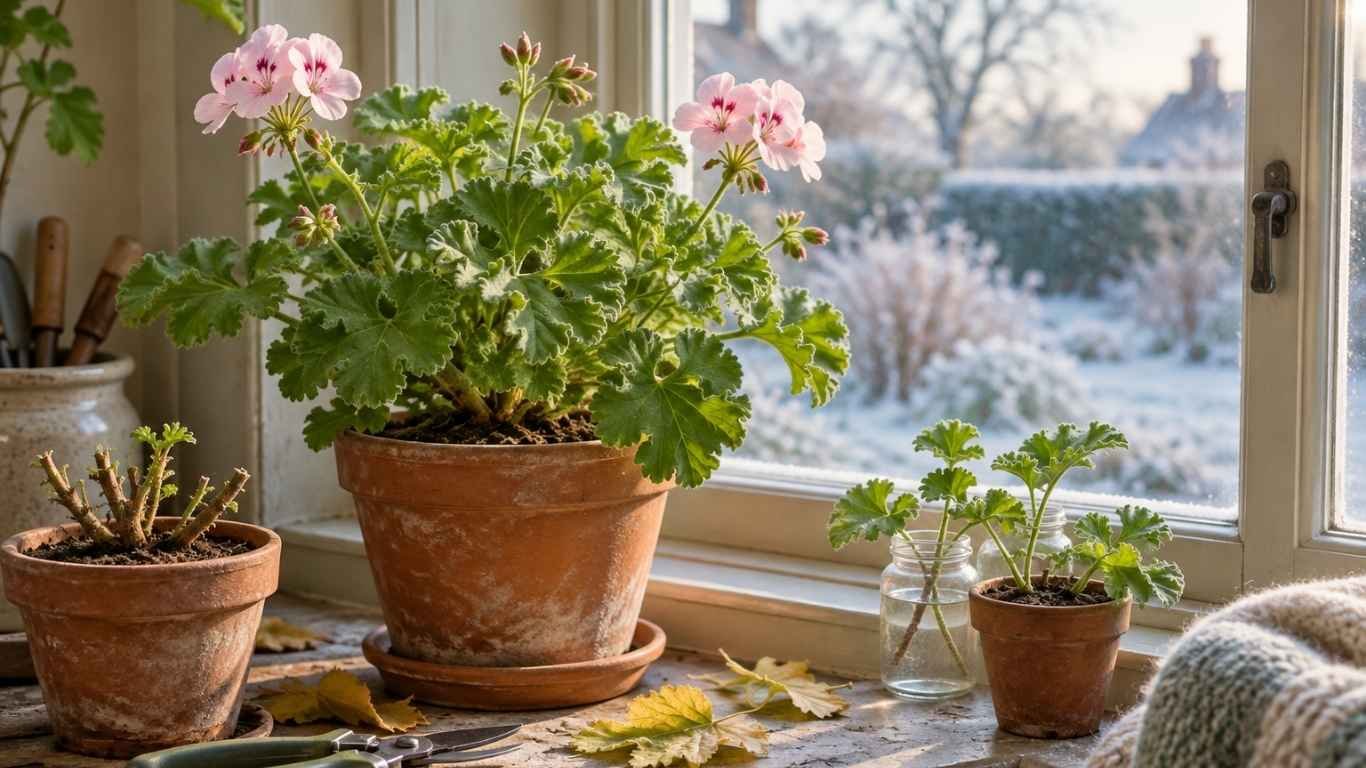
All summer your scented geranium released a puff of rose or lemon every time you brushed past it. Now it is on the windowsill, leaning towards the glass, dropping yellow leaves, and the scent gets fainter every week. Scented geraniums indoors rarely die of cold. They die of the combination that winter brings: too little light, too much warmth and wet compost.
This guide shows you how to set up the right winter spot, which of the three winter methods suits your space, how to take cuttings as insurance, and which varieties are worth growing for their leaves.
Table of Contents
Why scented geraniums struggle indoors in winter
Scented-leaved pelargoniums come from warm, bright, dry places. The Royal Horticultural Society (RHS) says they need well-drained soil, will not thrive in damp soil, can be disappointing in shade and will not take a frost. Winter indoors gives them the opposite of all three.
- Too little light. On a dim windowsill the stems stretch towards the glass and the new leaves come small and pale. The scent comes from oils in the leaves, and the RHS notes that full sun helps develop them.
- Warmth without light. A heated room pushes the plant to grow, but there is not enough light to grow well. The result is soft, leggy growth.
- Wet, cold compost. Pelargoniums are not thirsty plants. The RHS warns that damp conditions and poor air circulation favour diseases such as grey mould.
Fix those three and most scented geraniums come through winter without trouble.
Scented geraniums indoors: the winter set-up
Bring every pot in before your first autumn frost. In a Central European garden that is usually some time in October; use your own first-frost date. Before the pot comes inside, pick off yellow leaves and check under the leaves and around the stems for whitefly.
| What it needs | How to give it |
|---|---|
| Light | Your brightest window, ideally south- or west-facing. Turn the pot a quarter turn each week so it grows evenly. |
| Temperature | Frost-free at all times. A cool room is better than a warm one: the RHS says many pelargoniums keep flowering at 7–10°C (45–50°F). Keep pots away from radiators. |
| Water | Sparingly. Let the compost dry between waterings. Lift the pot: if it still feels heavy, wait. |
| Feed | Once a month in autumn and winter if the plant is growing. None at all if you have cut it back hard. |
| Air | Open the window on mild days. Moving air helps prevent grey mould. |
| Compost | Free-draining. The RHS suggests adding grit, perlite or vermiculite to the compost for scented-leaved types. |
A young plant is happy in a pot about 12–15 cm (5–6 in) across, a mature one in 15–20 cm (6–8 in). Do not move a plant into a bigger pot in autumn. More compost holds more water, and winter is when it stays wet longest. Repot in mid-spring instead.
Which winter method suits your space?
The RHS describes three ways to bring pelargoniums through winter. Two of them suit a home without a greenhouse. Answer the questions below and pick yours.
- Do you have a bright windowsill with room for the whole plant?
Yes: keep it growing (method A). No: go to question 2. - Do you have a bright, cool, frost-free spot, such as an unheated spare room, a bright stairwell or an enclosed porch?
Yes: cut it back and keep it nearly dry (method B). No: take cuttings and keep only those (method C).
Method A: keep it growing on the windowsill
Leave the plant at full size, water sparingly and feed once a month. Pinch out the tip of any stem that starts to stretch. This is the method that keeps the leaves to hand all winter, which is the point of a scented geranium. It works best in a cool room.
Method B: cut back and rest
Cut the stems back to about 10 cm (4 in), as the RHS suggests when space is short. Keep the pot in a light, airy, frost-free place. A cut-back plant needs barely any water until it starts growing again in spring. Check it once a week and open a window on mild days.
Method C: keep cuttings instead of the plant
The RHS calls cuttings more reliable than keeping old plants semi-dormant. A tray of rooted cuttings takes up a fraction of the windowsill, and a big, woody plant can then go on the compost heap. Take them as early as you can. Late summer is ideal, and the RHS says pelargonium cuttings can be taken from spring right through to autumn.
How to take scented geranium cuttings
Pelargoniums are one of the plants the RHS lists for softwood cuttings, which root from soft young shoot tips.
- Choose healthy, non-flowering shoots. Cut them in the morning, when they are full of water.
- Take up to 10 cm (4 in) of shoot, cutting just above a bud on the parent plant.
- Trim each cutting just below a leaf joint, so it is 5–10 cm (2–4 in) long. Remove the lower leaves.
- Push the cuttings around the edge of a small pot of gritty compost, so the leaves do not touch.
- Water once, then keep them on a bright windowsill out of scorching sun. Water only when the surface is dry.
- When they start to grow, pinch out the tips to make them bushy. Pot each one into its own 9 cm (3½ in) pot in mid-spring.
Keep the leaves you trimmed off. They smell as good as the plant and can go straight into a winter simmer pot.
Six scented geraniums worth growing for their leaves
The scent is in the leaves, released when you rub them, and it is there all year. All six below hold the RHS Award of Garden Merit. Heights are the RHS figures for a full-grown plant; on a windowsill you keep them smaller by pinching.
| Variety | Scent | Scent family | Height | Good to know |
|---|---|---|---|---|
| ‘Attar of Roses’ | Rose, from leaves and flowers | Floral | 0.5–1 m | The classic rose geranium. Deadhead to keep it flowering. |
| ‘Lady Plymouth’ | Rose with fresh mint | Floral / Herbal | 0.5–1 m | Cream-edged leaves, pretty on a windowsill all winter. |
| Pelargonium crispum ‘Variegatum’ | Lemon | Citrus | 0.5–1 m | Small, crinkled, cream-edged leaves on upright stems. |
| Pelargonium tomentosum | Peppermint | Herbal | 0.5–1 m | Soft, velvety leaves and a wide spread, up to 1 m. Give it room. |
| Pelargonium odoratissimum | Apple | Sweet | 0.1–0.5 m | Low and spreading. Good at the front of a windowsill. |
| ‘Royal Oak’ | Balsam | Woodland | 0.1–0.5 m | Oak-shaped leaves; one of the more compact choices. |
For each of them: light full sun or your brightest window; pot 12–20 cm (5–8 in); scent all year, released by touch and strongest in warmth and sun; effort low once you have the watering right.
Where to put them so you actually smell them
Scented geraniums do not perfume a room on their own. You smell them when you touch them. So put them where your hand passes every day:
- on the kitchen windowsill beside the sink or the kettle;
- by the front door, if the window there is bright;
- on the table where you sit with your morning coffee.
Rub one leaf as you pass. That small habit is most of the pleasure of growing them.
What is wrong with my scented geranium?
| What you see | Most likely cause | What to do |
|---|---|---|
| Long, pale, leaning stems | Too little light, often with too much warmth | Move to the brightest, coolest window. Pinch out the stretched tips; root them as cuttings. |
| Lower leaves turn yellow and drop | Normal autumn shedding, or compost kept too wet | Pick them off. Let the compost dry before you water again. |
| Grey, fuzzy mould on leaves or stems | Grey mould, encouraged by damp and still air | Remove the affected parts. Water less and open a window on mild days. |
| Stem base black and soft | Rot from wet compost | Take cuttings from any healthy tips today. The base will not recover. |
| Tiny white insects fly up when touched | Whitefly | Check under the leaves and treat early, before the colony grows. |
Spring: when they go back outside
In late winter, start feeding a growing plant again and pinch out the tips to make it bushy. Repot in mid-spring. Wait until frosts have passed before the pots go outside, then harden them off over about two weeks, as the RHS advises. In a Central European garden that usually means the middle of May; check your own last-frost date.
Many herbs need a winter decision like this one. Our guide to overwintering herbs sorts lemon verbena, rosemary and the rest into stay out, shelter or bring in.
Pets
The ASPCA lists all Pelargonium species as toxic to dogs, cats and horses, with vomiting, loss of appetite, depression and dermatitis as the signs. If your cat chews houseplants, keep scented geraniums on a sill it cannot reach, and see the ASPCA entry for geranium.
Frequently asked questions
Can scented geraniums stay outside in winter?
No. Scented geraniums are tender pelargoniums and will not take a frost. Bring them indoors before your first autumn frost, and put them back out only after the last frost in spring.
How often should I water scented geraniums indoors in winter?
Only when the compost has dried out. In a cool room that may be every one to three weeks; in a warm room more often. A plant that has been cut back hard needs barely any water until it grows again.
Why is my scented geranium getting leggy indoors?
It is not getting enough light for the warmth of the room. Move it to a brighter, cooler window, pinch out the stretched tips, and root those tips as new plants.
Should I cut back scented geraniums for winter?
Only if you are short of space. A plant kept growing on a bright windowsill can stay full size. If you cut back, go to about 10 cm (4 in) and keep the plant nearly dry until spring.
Can I use scented geranium leaves?
Yes. The RHS notes that the leaves can be used fresh or dried in pot pourri, or to flavour sugars and tisanes. Our gifts from the garden guide has a scented sugar to make with them.
Are scented geraniums the same as hardy geraniums?
No. Scented geraniums are pelargoniums, which the RHS calls “tender geraniums”. Hardy geraniums, or cranesbills, are a different genus that stays outside all year.
Your next step
Before tonight’s forecast drops, bring your scented geraniums in and give each one the brightest, coolest window you have. Then take three cuttings from your favourite, just in case.
Tell us in the comments: which scented geranium do you grow, and what does it smell of to you?
Next, read Overwintering Herbs: Bring It In, Take a Cutting, or Start Again? for the rest of your pots.
Sources
- RHS: How to grow pelargoniums
- RHS: Scented-leaf pelargoniums
- RHS: Softwood cuttings
- Gardeners’ World: Scented-leaf pelargoniums to grow
- ASPCA: Geranium
Last updated: 10 October 2026 · Scented Garden